Dear Friend,
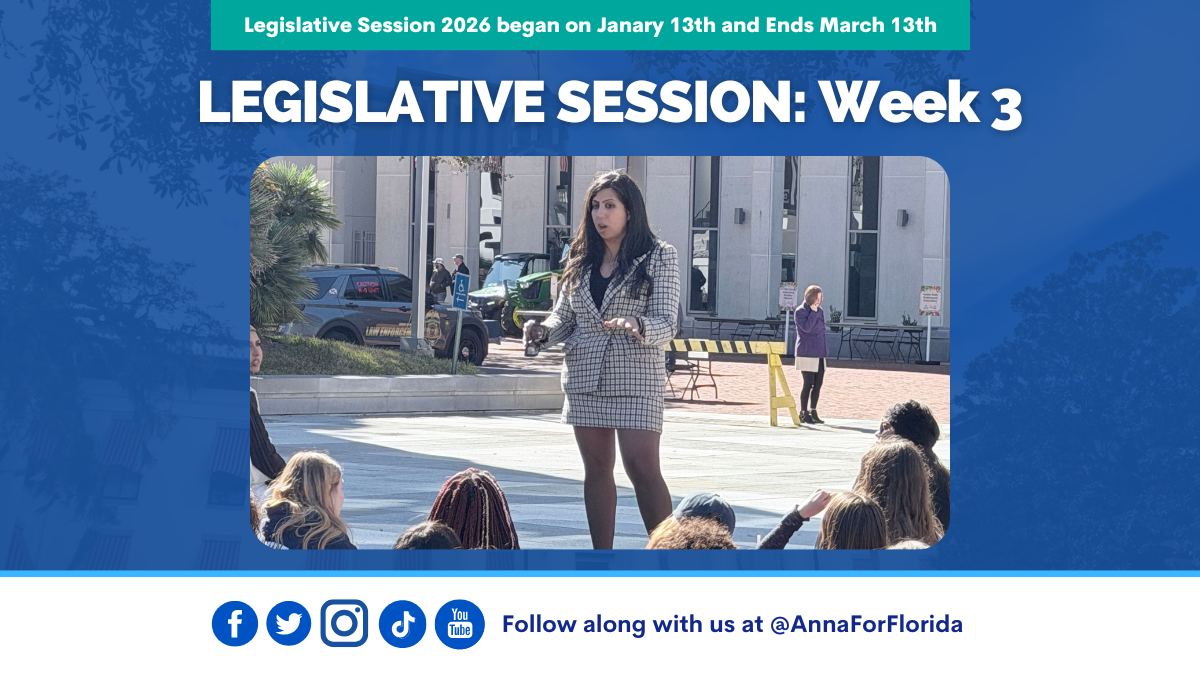
Last week was the third week of the 2026 Legislative Session, and it was the busiest one yet.
An amendment was slipped into what had been a good bill to undermine the rural boundaries in Orange and Seminole counties. House Republicans unveiled a plan to sharply cut the number of out-of-state students at top Florida universities. And we learned that the massive tax cuts that President Trump and Congress gave to corporations last year are about to rip open a giant hole in the new state budget that must pass before June 30.
But I’m also thrilled to report that a bill I’m sponsoring to help Floridians who rely on wheelchairs or other mobility devices cleared its final committee – unanimously – and is now ready for a vote on the House floor.
We’ve got updates on all those bills and more in our Week 3 update, available below.
The session is in full swing now. Committees are meeting every day, and dangerous amendments can surface at any time. Please follow us on all our social media channels for updates as they happen. You can find us on Facebook, Instagram, and YouTube.
Let’s make sure that everyone in Tallahassee knows that we’re paying attention.
Onward,

‘Right to repair’ for wheelchairs and mobility devices clears final committee
Let’s start with some good news this week: A bill I’m sponsoring to make sure that wheelchair users can find affordable repairs when their chair breaks passed its second – and final – committee last week.
House Bill 487 is what’s called a “right to repair bill.” It would require manufacturers of wheelchairs and other personal mobility devices to provide owners with access to the parts, tools, and information needed to repair a malfunctioning device. The wheelchair market is dominated by a few large companies that can artificially obstruct efforts to repair wheelchairs. They would rather have people buy new wheelchairs, which can sometimes cost nearly as much as a new car.
My bill would prevent that from happening and give everyone the option to pursue repairs if they want. The legislation passed the House Commerce Committee unanimously and now heads to the full House of Representatives.
This isn’t the only right-to-repair bill moving this session. The Senate Agriculture Committee also unanimously passed Senate Bill 806, which would make sure farmers aren’t unfairly stopped from making repairs to broken tractors and other agricultural equipment.
Development lobby tries again to undo rural boundaries in Orange and Seminole counties
There’s yet another attempt in Tallahassee to undo the will of Orange County and essentially wipe out the county’s new rural boundary.
A provision slipped into House Bill 399 last week would erase the requirement to dissolve the new Orange County rule that requires any attempt to rezone rural land be approved by a supermajority vote of the county commission, rather than a simple majority.
HB 399, which passed the House Intergovernmental Affairs Committee, would also undo similar supermajority protections for rural land in Seminole and Miami-Dade counties, too.
This is one of several developer-backed bills that appear to be moving quickly in this year’s session. A few others that passed committees last week:
- House Bill 105, which would give developers more legal ammunition to sue if a county denies a development order or some other permit
- Senate Bill 332, which would allow more secret meetings between lawyers for big property owners and local governments to negotiate settlements to claims filed under the Bert Harris Act
- House BIll 691, which would make it easier for homebuilders to build new subdivisions on rural land adjacent to developed areas
- House Bill 1139, which would help developers block local governments from raising impact fees
Trump’s corporate tax cuts and safety net cuts rip open a big hole in Florida’s budget
One of the biggest and most important stories of this year’s legislative session is fallout from the enormous safety net cuts and corporate tax breaks that President Donald Trump and Congress passed last year as part of their so-called “One Big Beautiful Bill.”
To pay for their tax cuts, which overwhelmingly favored the very rich, the president and Congress imposed deep cuts to health insurance through Medicaid and the Affordable Care Act and on food assistance through the Supplemental Nutrition Assistance Program (SNAP).
But they also passed even more costs associated with those programs onto states, and some Republicans in Tallahassee want to use that as an excuse to make even bigger benefit cuts.
That’s partly what’s behind House Bill 693, a bill that would have the effect of kicking even more Floridians off health insurance and food assistance by limiting eligibility and imposing bureaucratic paperwork requirements even beyond what the president and Congress have already done. The House Health Care Facilities & Systems Subcommittee passed that legislation last week.
But that’s just the start of the fallout from the Trump tax cuts. The Senate Finance and Tax Committee held a workshop at which we learned that the largest corporations in Florida could receive billions in additional state tax savings unless we, as a Legislature, take steps to “decouple” the corporate tax code from the new federal corporate tax breaks.
If we don’t, it would create a $3.5 billion shortfall in next year’s budget, forcing even deeper cuts to education, healthcare, transportation, and other critical services. My hope is that we use this as an opportunity to pursue meaningful tax reform by closing corporate tax loopholes through combined reporting.
This will be a big story to watch over the next few weeks.
Bill would let state officials target ‘domestic terrorists’
An ominous new bill began moving last week that would give the governor’s administration the power to designate groups as “domestic terrorist organizations” and impose sanctions, both on the groups themselves and people involved with them.
House Bill 1471 passed the House Civil Justice & Claims Subcommittee despite pleas and warnings from members of the public who say the legislation is vague and could be weaponized by a governor against political opponents.
This is something we need to be very careful with. We literally have senior people in the Trump administration lying about American citizens who have been murdered by masked government goons by claiming they are “domestic terrorists.”
Education bills would cut out-of-state students at top universities, open a loophole in school vaccine rules, and ban more books from libraries
There was a lot happening on the education front – some of it potentially damaging or dangerous.
The House Careers & Workforce Subcommittee passed House Bill 1279, a wide-ranging higher education bill that would dramatically reduce the number of out-of-state students that the University of Florida and our other top public universities can enroll. The bill would require that at least 95 percent of incoming freshman classes at UF and other schools receiving preeminence funding be in-state students. In addition to UF, this would also impact Florida State University, the University of South Florida, Florida International University, and the University of Central Florida/
The Senate Health Policy Committee passed Senate Bill 1756, which would allow parents to send kids to public schools without any immunizations at all if they object to vaccine requirements on the basis of “conscience.” This bill would also bizarrely allow pharmacies to sell Ivermectin without a prescription – and yet also give medical providers legal immunity from side effects of Ivermectin.
The House Education & Employment Committee passed House Bill 1119, which is basically a book-banning bill on steroids. It would prohibit school districts from considering the literary or artistic value of a book that a fringe activist wants banned from school libraries.
The House PreK-12 Budget Subcommittee passed House Bill 1071, a major prekindergarten-through-grade-12 education bill. One part of this bill would give the DeSantis-appointed State Board of Education the power to force public schools to show students an anti-abortion video developed by an extremist organization as part of their regular health education curriculum.
There was at least some good news with this bill, though. The sponsor removed a provision added to the bill during its first committee hearing that would have required schools to admit any law enforcement officer to camps. There was a lot of concern that the language would open the door to immigration raids in schools.
Reproductive freedom under attack, again
The bill potentially forcing schools to show students an anti-abortion propaganda video was the only piece of legislation that moved forward last week, attacking reproductive freedom.
The Senate Civil and Criminal Justice Appropriations Committee passed Senate Bill 164, which would give fertilized eggs some of the same legal rights as a living human child – a ploy designed to empower a court to completely ban all abortion. The legislation could even enable an abuser who impregnates a woman to sue her healthcare provider if she gets an abortion.
Meanwhile, the House Health & Human Services Committee passed House Bill 173, which would make it much harder for teenagers to access healthcare services. Among other things, it would stop a 17-year-old from obtaining birth control or treatment for a sexually transmitted infection without written permission from a parent.
Anti-worker bills would bust unions and undermine Florida’s minimum wage
A couple of terrible anti-worker bills started moving last week, too.
House Bill 995 is a new union-busting bill being pushed by a couple of billionaire-funded groups seeking to crush employee collective bargaining rights nationwide. This bill, which passed the House Government Operations Subcommittee, would make it even harder for many of our public-sector workers – such as teachers, custodians, school bus drivers, cafeteria workers, city clerks, and many others – to form and maintain labor unions.
Then there’s House Bill 221, which has been around for a few years and would allow companies to pay less than the minimum wage to some workers, including interns and apprentices. One of the dangers of this bill is that it is blatantly unconstitutional – almost as if it is designed to set up a court case that some extremist judge could use to strike down the state minimum wage.
The anti-minimum wage bill passed the House Industries & Professions Subcommittee.
An idea only the fossil fuel industry could love
The Senate Environment and Natural Resources Committee passed a new bill that the fossil fuel industry will love.
Senate Bill 1628 would forbid cities, counties, and other local governments from adopting policies meant to reduce greenhouse gas emissions and combat climate change. This would block everything from “net zero” policies that set a goal of reaching carbon-neutral energy consumption to basic procurement ordinances encouraging the purchase of electric vehicles over gas-guzzling cars.
The legislation would also strike down local green and renewable energy ordinances already in place.
Property taxes and preemption
Even though the governor and Senate still aren’t doing anything on property taxes, the House keeps moving forward with its bills.
The latest is House Joint Resolution 213, which passed the House State Affairs Committee. It would suppress the taxable values of properties so that the value of a homestead property could not rise more than 3 percent every three years (the cap is 3 percent a year right now) and the value of any other property could not rise more than 15 percent every three years (versus 10 percent a year right now).
This is a really dangerous idea because it would take one of the biggest problems with our current property tax system – where two neighboring owners of identical homes can pay wildly different property tax bills based solely on when they bought their home – and make those inequities so much worse.
Even as they sought to shift tax revenue to the state, many of my Republican colleagues continue to strip governing powers from local governments.
The latest preemption is Senate Bill 1444, which passed, stripping cities, counties, and towns of the power to set rules around everything from churches to home playgrounds to golf clubs. This bill – which I suspect will also be used as a vehicle for last-minute amendments that include even more local government preemptions – passed the Senate Community Affairs Committee.
Rays of sunshine: Cleaning up the ‘Hope Florida’ mess, cracking down on insurance industry shell games, and restoring the Ocklawaha River
I want to be sure to lift up a few good bills that passed this week:
- House Bill 593, which would prevent the DeSantis administration or any future governors from essentially laundering money from legal settlements as DeSantis and now-Attorney General James Uthmeier did during the “Hope Florida” scandal
- House Bill 1399, which passed House Commerce Committee, would make it harder for property insurance companies to use accounting tricks and financial shell games to pocket excess profits
- House Bill 981, which passed the House Budget Committee, would set in motion the restoration of the Ockalawaha River, which is the largest tributary to the St. Johns River but is currently blocked by a more than half-century-old dam that was built as part of a cross-Florida barge canal that was never actually completed
Pandering to Trump
It’s looking like a whole bunch of my colleagues want to rename Palm Beach International Airport the “Donald J. Trump International Airport” – and then make sure nobody can change it back.
That’s what Senate Bill 706 and House Bill 919, would do. They strip the cities and counties that own Florida’s major airports – including the city of Orlando, which owns Orlando International Airport – of the power to name their airports. And then the bills would rename Palm Beach’s airport after Trump.
It seems more than a little reckless to be naming things after Trump right now when he still has three years left in his term – and no one has any earthly idea what he will do over the next three years. But that’s not slowing these bills: SB 706 passed the Senate Transportation Committee, and House Bill 919 passed the House Economic Infrastructure Subcommittee
Favors for Philip Morris and Mosaic
The Trump airport bill is one of those bills that’s designed to create controversy and draw media attention – distract from uglier bills that do favors for big corporations and other special interests. And we saw a bunch of those clear committees last week, including:
- House Bill 167, which passed the Senate Rules Committee, would shield the Mosaic Co. from lawsuits related to the radioactive material it leaves behind on former phosphate mines
- House Bill 377, which passed the House Ways & Means Committee, would give a tax break to Big Tobacco giant Phillip Morris International
- Senate Bill 1512, which would enable Space Florida to help private companies get big property tax breaks without ever going through a vote in either the Legislature or before a local county commission
That said, one major corporate bill encountered some trouble: Senate Bill 290. This is a giant “farm bill” being pushed by Agriculture Commissioner Wilton Simpson. But tucked away down inside it is a gift for the sugar industry that would make it easier for Big Sugar to silence Everglades activists and news media by threatening expensive defamation lawsuits.
SB 290 was scheduled for a hearing before the Senate Rules Committee. But it was instead “temporarily postponed” for at least a week – partly because a growing number of people are concerned about letting the sugar industry trample all over the First Amendment.
Mandatory life for manslaughter
The Florida Senate passed Senate Bill 156, which would mandate life sentences for anyone convicted of manslaughter after inadvertently killing a police officer in an altercation.
Senators opted not to consider an amendment that would have also required a life sentence for any police officer convicted of manslaughter after inadvertently killing someone in an altercation.
The bill now comes to the Florida House.
Grab bag: Gold, crypto, and scratch-offs
Finally, a quick round-up of a few more bills that moved forward last week:
- Senate Bill 530, which let people buy lottery tickets from vending machines with debit cards, passed the Senate Regulated Industries Committee
- Senate Bill 1038 and Senate Bill 1040, which together would create a state cryptocurrency reserve fund, passed the Senate Banking and Insurance Committee
- House Bill 1311, which would authorize gold and silver as legal tender in Florida, passed the House Insurance & Banking Subcommittee
- House Bill 1421, which would lead to the state leasing some of its conservation land for cattle grazing, passed the House Natural Resources & Disasters Subcommittee
- House Bill 1461, which would authorize advanced nuclear reactors in Florida, passed the House Economic Infrastructure Subcommittee