Dear Friend,
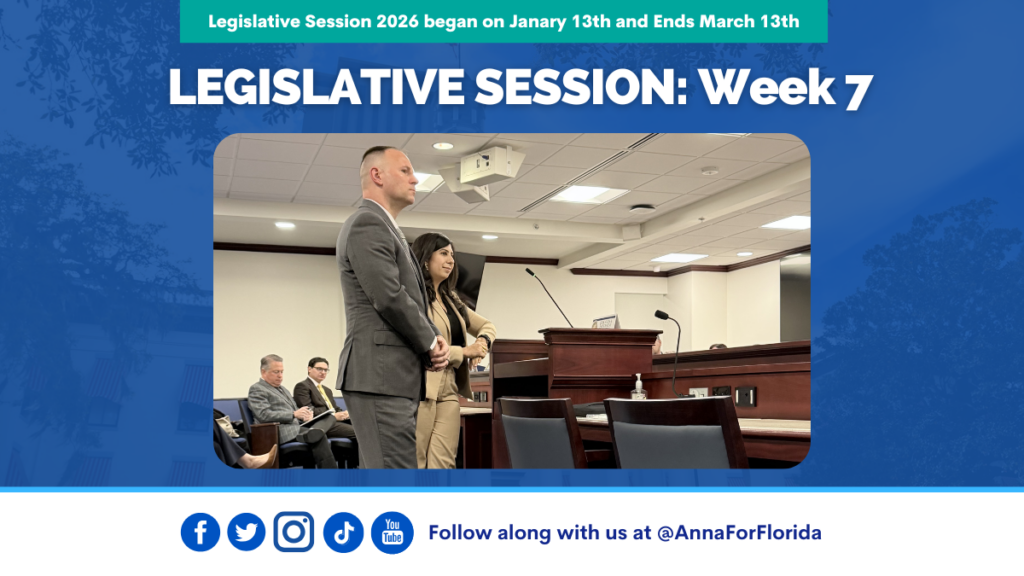
We’re getting very close now to what should be the end of the 2026 Legislative Session.
Last week was Week Seven of the normally-nine-week session, and it was intense. Republican leaders fast-tracked bills intended to suppress the vote among college students and others, penalize public school teachers and their unions, and give the executive branch dangerous new authority to designate ideological opponents as domestic terrorists.
Developer lobbyists also launched a sneak attack on the rural boundaries in Orange and Seminole counties And they continued to push forward with a “blue ribbon projects” bill that would allow city-sized projects to be developed in the middle rural communities with minimal public input.
But we also made good progress in our efforts to stop giant tax cuts for corporations, preserve health insurance and food assistance, and protect First Amendment rights from infringement by Big Sugar. And two bipartisan bills I’m sponsoring – to help prevent accidental drownings and school elopements of kids with autism – cleared their final committees.
We’ve got lots more information about those bills and many others in our Weekly Update below.
It’s still not at all clear when the session will actually end. House and Senate leaders have yet to make any progress on top-level budget negotiations, and we have yet to begin the budget conference process.
But even if we have to extend the session or come back later in the year for a budget-focused special session, these next two weeks will be critical. It’s very likely that we will still have to wrap up work on all non-budget policy bills by Day 60. That means the fate of a lot of legislation – some of it good, much of it bad – will be decided by March 13.
So if you’re not already, make sure to keep in touch with us through our social media channels – Facebook, Instagram, and YouTube – where we will be posting real-time updates, breaking news, and urgent calls to action.
We can’t let down our guard now.
Onward,

House passes elections bill designed to suppress turnout – especially on college campuses
The Florida Legislature is on the brink of passing a far-reaching elections bill that is designed to suppress turnout among groups of people that Republican leaders in Tallahassee don’t want to vote, including college students, women, and elderly people of color.
The Florida House of Representatives passed its version of the legislation, House Bill 991, last week. Among other things, it would require people registering to vote for the first time to prove their citizenship by presenting documents such as a birth certificate or an active passport. But that’s not all: It would also allow state officials in Tallahassee to go through the voter rolls, cherry-pick Floridians who are already registered, and cancel their registration unless they, too, can produce these documents.
That’s going to place an enormous burden on certain folks – like college students who may not have ready access to these records, women who have changed their last names as a result of marriage or divorce, and elderly Black people who may never have been issued a birth certificate because of historic racism in healthcare. It’s also a financial barrier for some folks who may have lost their birth certificate or never obtained a passport, who would now have to apply for replacement records.
I also want to emphasize one other particularly noxious change in HB 991: A new restriction on students at our public colleges and universities that would prevent them from using their student IDs as identification when they show up to vote.
Once a student registers with either their driver’s license or Social Security Number, they should be able to vote with a valid photo ID from their public institution. This is the current policy, and it has worked very well. The bill maintains all forms of public IDs — including a concealed weapons permit — except for public educational institutions.
This change makes no sense, is very likely unconstitutional, and is quite obviously just another way to make it harder for students to vote.
Unfortunately, the Florida Senate has put a similar bill on the fast track this session. Senate leaders decided to withdraw Senate Bill 1334 from its final committee of reference, which means it can now go straight to the Senate floor.
We’re obviously still fighting. The Senate bill, at least, does not include the restriction on the use of student IDs.
Legislative leaders put union-busting and “domestic terrorist” bills on the fast track
Unfortunately, two other terrible bills have been fast-tracked as we near the possible end of session.
One would severely restrict the collective bargaining rights of teachers, bus drivers, utility workers, nurses, custodians, and many other public-sector workers. It would, for instance, raise the voting threshold employees would need to reach to win unionization or recertification elections, from a majority of workers voting in the election to a majority of all workers covered by the union, regardless of whether they participate in the election.
Of course, yet again, my Republican colleagues are exempting the unions they politically support – police unions, firefighter unions, and corrections officer unions – from all of these new restrictions.
What they are really trying to do is bust the teacher unions. But this would also harm so many more workers – including, by the way, private sector workers who receive higher pay and benefits in places where there are higher rates of unionization at public-sector employers.
The House version of this bill, House Bill 995, passed the House State Affairs Committee last week and is now ready for a vote in the full House. The Senate version, Senate Bill 1296, was also withdrawn from one of its committees and is now scheduled for a final committee hearing this week.
The other dangerous legislation, suddenly moving at light speed, would give the governor the power to designate ideological groups he does not like as “domestic terrorist organizations.” The designation would carry harsh financial and potentially criminal sanctions for groups and their members – including the expulsion of university students who support these groups. And these sanctions could take effect even before an organization has a chance to challenge the “domestic terrorist” designation in court.
The Senate version of this bill is Senate Bill 1632, and it just barely squeaked through the Senate Criminal and Civil Justice Subcommittee last week by one vote. But Senate leaders then immediately withdrew it, too, from its final committee of reference, making it available for a floor vote.
Meanwhile, the House is expected to vote on its version of the domestic terrorism bill, House Bill 1471, this week.
Developers launch sneak attack on rural boundary protections
A last-minute scheme emerged in the Florida Senate last week to destroy the rural boundaries in Orange and Seminole counties.
An amendment filed by Sen. Jonathan Martin (R-Fort Myers Beach) – and supported by Central Florida Sen. Jason Brodeur (R-Sanford) – would essentially force the two central Florida counties to allow real estate developers build high-density commercial projects on land that was supposed to remain rural or pay the developers full-market prices for the property
Martin filed the proposed amendment to Senate Bill 208 just before a meeting of the Senate Rules Committee. Martin withdrew it without a vote, but vowed to file it again when the legislation gets to the Senate floor – and Brodeur announced that he would support it. Read more about the machinations in the Orlando Sentinel.
This isn’t the only effort to eliminate rules meant to save rural land and slow suburban sprawl. Another bill – House Bill 399, which passed the House State Affairs Committee – would significantly weaken the rural boundaries around Orlando and similar zones in Miami by preempting rules that require development approvals to pass by a supermajority vote of the local county commission.
House Bill 399, which was also expanded to help the Fontainebleau Hotel get approval for a controversial waterpark in Miami Beach, will be heard on the floor of the House this week.
An update on Anna’s bills: Drowning prevention and student elopement clear final committees
In better news, a pair of bipartisan bills I’m sponsoring this session passed their final committees last week and are now ready for votes in the full House.
One of the bills, House Bill 503, would help prevent accidental drownings among newborn babies and young children. It would require hospitals, birth centers, home birth providers, and other childbirth educators to distribute educational materials on safe-bathing practices and drowning prevention to new or expecting parents and caregivers.
House Bill 503 passed the House Health & Human Services Committee last week by a unanimous vote. Even better, it’s already been scheduled for a hearing on the House floor this week. And a similar bill has already passed the Florida Senate – thanks in large part to Sen. Carlos Guillermo Smith (D-Orlando) – which means this legislation is getting very close to passing.
Then there’s House Bill 423, which would ensure schools have safety plans in place for children who have a tendency to wander off – a common occurrence among kids with autism.
Under the legislation, public schools would have designated response teams that could respond immediately if a student wandered off campus during the school day. These “SAFE Teams” – would also be tasked with developing proactive elopement plans in coordination with parents of students at risk of elopements. They would also prepare quick reference guides that could be used if an elopement occurs; the guides would include information like a current photograph, the child’s communication abilities, important medical considerations, and potential locations a student must go.
HB 423 passed the House Education & Employment Committee – also with unanimous support. It’s now ready for a vote in the
A third bill I’m sponsoring this session has already been through all its committees and is now awaiting a hearing on the House floor: House Bill 487, a “right to repair” bill for users of wheelchairs and other personal mobility devices. That legislation would ensure that people who rely on wheelchairs and similar devices have the option to repair broken devices – rather than always being forced to buy a new one.
I’m really proud that all three of these bills have Republican co-sponsors, too.
House passes K-12 education package, but differences with Senate remain
The House passed a big K-12 education bill last week that includes several components that I support and see as good education policy.
But there are also many components of House Bill 1071 that are very concerning – including a provision that would allow for an anti-abortion propaganda video to be shown to all public school students, beginning in sixth grade.
It’s known as a “Baby Olivia Bill.” And it is both unacceptable and ironic. Many of my colleagues often preach against ‘indoctrination’ in schools, and yet this is one of the most brazen examples of attempted indoctrination we have ever seen in Florida.
The good news is that this language is not in the Senate’s corresponding K-12 package, Senate Bill 7036, which also moved forward last week. I am hopeful it will not be included in the final legislation.
More education bills on the move: Small private schools, partisan college accreditation, and a new subsidy for charter schools
A few other education items to note:
- House Bill 1071 and Senate Bill 7036 have both been amended to allow small private schools – schools of up to 150 students – in any area zoned for commercial or industrial development and to operate inside a wide variety of commercial businesses, including retail stores and movie theaters.
- Both chambers are also moving higher education packages that would enable our state colleges and universities to stop going through independent accreditation and instead get accredited by a politically-controlled accrediting agency that the state of Florida is starting called the Commission for Public Higher Education. The Senate’s bill, Senate Bill 7038, cleared its final committee last week while the House’s version, House Bill 1279, will be heard on the floor this week. There are still significant differences between the two packages, though.
- The Senate’s proposed “tax package,” which is Senate Bill 7046, includes language that would force school districts to give some of the money they raise from voter-approved property taxes with privately managed charter schools that the school districts did not authorize.
Legislative leaders break with Trump on corporate tax cuts
Speaking of taxes, the House and Senate last week both rolled out their versions of the “tax package,” which is basically a giant bill containing a bunch of different tax breaks and other tax changes.
The House tax package is much better, though it definitely has some parts that I don’t like. On the positive side, it includes some Democratic-proposed policies to help first-time homebuyers and middle-class homeowners trying to harden their homes against hurricanes.
The parts I’m not a fan of include tax breaks for gun accessories like barrels, magazines, and holsters, plus major sales and property breaks for defense contractors and other companies that negotiate incentive deals through Space Florida
But most importantly, the House bill would also completely “decouple” from the massive corporate tax breaks that President Donald Trump and Congress gave to corporations last year as part of the so-called “One Big Beautiful Bill Act.”
Decoupling would save the state of Florida $7 billion over the next five years – money that would otherwise have just been given away to a small number of giant corporations. Now we can use that money to protect and invest in important public services like education, healthcare and transportation infrastructure, and in tax cuts for working families.
It’s looking like the Senate may agree to decouple from the Trump tax cuts, too, so this could wind up being a big win for Floridians this session.
More floor action: Conservation land, data centers and suburban sprawl
In another piece of good news, the Legislature has passed a bipartisan bill that would make it harder for the governor to sneak through deals giving conservation land away to developers.
House Bill 441 was prompted by the controversy that erupted last year when the DeSantis administration tried to give 600 acres in the Guana River Wildlife Management Area near St. Augustine to a mystery developer in exchange for a few random pockets of less valuable land in other parts of the state. The legislation would require state officials to give the public much more advance notice before completing a sale or swap of state conservation land – and to provide thorough public explanations of why they want to make the deal.
The legislation passed both the House and Senate on unanimous votes. It now goes to Gov. Ron DeSantis to sign or veto.
In other floor action last week.
The House passed not one but two bills renaming roads after President Donald Trump. Senate Bill 484 would designate all of State Road 80 – a 124-mile road running from Palm Beach to Fort Myers – as “President Donald J. Trump Highway.” And House Bill 33 would rename another road in Fort Lauderdale as “President Donald J. Trump Boulevard.” House Bill 33 would also rename a road in Miami after Charlie Kirk.
The Senate passed an important data center bill, Senate Bill 484, which would set new consumer and environmental protection rules around things like electricity usage, water consumption, and public disclosure.
The Senate also passed Senate Bill 686, known as the “agricultural enclaves” bill, which would make it easier for developers to build housing subdivisions on agricultural land on the fringes of urban areas.
‘Blue ribbon projects’ bill – a greenlight for mega-developments – gets closer to passing
The legislation known as the “blue ribbon projects” bill – which would make it much easier for the biggest landowners in Florida to get approval for city-sized developments on their land – continues to move forward.
The House version of the bill, House Bill 299, cleared its final committee last week, passing the House State Affairs Committee. There was a substantial amendment: The bill was changed so that the new development rules would apply only to tracts of land at least 15,000 acres (rather than 10,000 acres).
The rewritten version also gives at least a smidge of control to the local county commissions, rather than forcing them to automatically approve any qualifying development. But the scales are still so stacked in the developer’s favor that it’s really just an illusion of local control.
The Senate companion, Senate Bill 354, will be heard in the Senate Rules Committee this week. If it passes there, both of these bills will be ready for floor votes.
‘Food libel’ language stripped from ‘farm bill’
The House State Affairs Committee also passed the so-called “farm bill.” But only after the bill was changed to remove “food libel” language that would have enabled Big Sugar to sue journalists, environmentalists, and healthy food activists.
That dangerous language has now come out of both versions of the farm bill, including Senate Bill 290.
There are still some concerning aspects to the legislation, including parts that continue to strip away the home-rule powers of local governments and that would enable the state to sell off some conservation lands to agricultural companies. But the overall package is at least in a better place compared to where it began.
The House is now scheduled to hear the farm bill on the floor this week. If we pass it without any further changes, it would go to the governor. If we amend it, it will bounce back to the Senate.
Progress in the fight for access to health insurance and food assistance. But lots of work left to do.
One of the most potentially destructive policies under consideration this session is proposals to enact harsh new eligibility and reporting restrictions on our some of our most important safety nets: Medicaid and KidCare, which provide health insurance to low-income children and families, disabled folks, and elderly Floridians, and the Supplemental Nutrition Access Program, which provides food assistance for working-class people.
This is related to Trump’s “One Big Beautiful Bill Act,” which sought to offset some of the enormous tax cuts it gave to wealthy Americans and big corporations by cutting Medicaid and SNAP. But we’ve seen bills filed in the Florida Legislature this session that would go even further with restrictions.
Fortunately, one of those bills was substantially improved last week: House Bill 693, which was amended in the Health & Human Services Committee to remove language that would have kicked a number of otherwise-eligible children off of health insurance. But the bill – which will be heard on the House floor this week – would still erect unnecessary and harmful barriers to food assistance.
But Senate Bill 1758 is even worse. It would impose draconian changes on Medicaid in particular, even though Florida, one of just 10 states that has failed to expand Medicaid access under the Affordable Care Act, already does more than almost any other state in the country to restrict access to Medicaid.
Senate Bill 1758 will be heard this week by the Senate Appropriations Committee, the bill’s final committee of reference.
Insurance commissioner warns that a billionaire-backed insurance bill could cost Florida condo owners
With each passing day, it’s looking less and less likely that the Legislature is going to do anything at all to bring down the costs of another form of insurance that is critical to Floridians: Property insurance.
But hard as it is to believe, the Legislature may do something to raise property insurance prices – at least for condo owners.
Bills awaiting floor votes in both the House and Senate – House Bill 943 and Senate Bill 1028 – would require Citizens Property Insurance Corp., our public nonprofit insurance company for Floridians who cannot find affordable insurance on the private market, to start a new program through which surplus lines insurance companies could take over policies covering condo buildings and business properties.
The Office of Insurance Regulation has been waving all kinds of red flags around the bill, which our insurance commissioner has warned would likely lead to condo owners paying higher prices for insurance that doesn’t include any of the basic consumer protections that come with standard property insurance policies.
The Tampa Bay Times reported that this idea is being pushed through the Legislature by lobbyists for a billionaire Republican megadonor. The donor founded an insurance-services company called Ryan Specialty, which wants to get a contract from Citizens to manage these new surplus lines programs.
A state spy agency?
Do you want Ron DeSantis – or whoever our next governor is – to have the power to spy on you?
Well, that could happen under House Bill 945, which cleared its final House committee last week and is now ready for the House floor. The legislation would create a “counterintelligence” unit within the Florida Department of Law Enforcement that would have the power to conduct surveillance operations targeting people “whose demonstrated actions, views, or opinions are a threat or are inimical to the interests of this state and the United States of America.”
The legislation has prompted a groundswell of opposition from First Amendment and free speech advocates. The sponsor has promised to make changes addressing the concerns when the bill is brought up on the House floor, though we haven’t seen any amendments yet.
The Senate version of the bill, Senate Bill 1712, has cleared one committee so far – which means it could be available as a last-minute amendment sometime before session ends.
Criminal bills would make it harder to file complaints against police officers, easier to designate defendants as gang members
I wanted to flag two other criminal legal system bills that moved forward last week.
The first is House Bill 1283, which would prohibit people from filing anonymous complaints against police and correctional officers, unless the complaints come with corroborating evidence. The bill passed its final committee last week and is now ready for a floor vote. The Senate version, Senate Bill 1544, has been through one committee so far, which means it could be available as an amendment.
The other is Senate Bill 536, which would give prosecutors more ways to designate a defendant as a member of a gang, which increases the maximum prison sentence they could face. For example, a prosecutor could cite the testimony of another gang member claiming the defendant is part of their gang or even the defendant’s use of “gang-related language” on social media.
SB 536 cleared its second committee last week and will be heard this week in its third and final stop before the Senate floor. A matching bill, House Bill 429, has already passed the House.
The erosion of home rule continues
As we do every year, we’re seeing a large number of bills that undermine home rule, undo the will of local voters, and take powers away from independently elected city and county governments.
Last week, for instance, House Bill 1451 was amended in the House Commerce Committee to block a referendum recently passed by voters in the city of Gainesville to restore control of the city’s electric utility company, GRU, to the city commission. The Legislature and Gov. Ron DeSantis seized control of GRU from the city in 2023, and Gainesville voters have been fighting to get it back ever since.
During the same meeting, the House Commerce Committee also passed House Bill 1217, a bill written for the fossil fuel industry that would erase local green-energy policies and other ordinances intended to reduce emissions of greenhouse gases. Unfortunately, this proposal has also been slipped inside the Senate’s proposed tax package (Senate Bill 7046).
A corporate-funded ‘bill mill’ is behind another anti-union proposal
Another unfortunate thing we see all too often in Tallahassee is bills that are nothing more than clones of “model legislation” pushed by the American Legislative Exchange Council – the corporate-funded bill mill that has its tentacles into state Legislatures across the country.
One of the most brazen examples this year is House Bill 1387, which essentially tries to turn economic development programs into union-busting tools. The bill – a nearly word-for-word clone of one of ALEC’s proposals – would forbid any company that receives tax incentives or cash grants from the state of Florida from voluntarily recognizing a new union when enough employees collect enough unionization cards.
Even worse, the bill would even forbid companies from simply agreeing to remain neutral in a union election – yet another ironic policy coming from so many of our colleagues who so often pretend to be absolutists when it comes to free markets and free speech.
Irony alert: A reckless piece of public health legislation is on life support
Lastly, I wanted to flag a dangerous public health bill that is – hopefully – dead for this session.
It’s Senate Bill 1756, and it would do two main things. First, it would allow anti-vaccine parents to ignore public school immunization rules and send unvaccinated children to schools even when doing so would put other kids’ health at risk.
Second, the legislation would basically deregulate Ivermectin, a dewormer medication often used in horses that became popular in right-wing spaces during the Covid pandemic. Senate Bill 1756 would allow pharmacies to sell Ivermectin for human use without any prescription – although, ironically, the bill would at the same time also give legal immunity to healthcare providers who supply the drug in case the buyer then experiences harmful side effects.
The legislation has passed two committees in the Senate so far, although it barely squeaked through each, and some Republican senators voted against it both times. And the House version, House Bill 917, hasn’t yet been heard at any committee, which means it is unlikely to pass at this point.