Dear Friend,
The Florida Legislature gaveled its 2026 regular session to a close a little after 3 pm Friday.
This year’s session came at a time when Floridians are facing a growing affordability crisis. From rising housing costs and skyrocketing insurance premiums to the everyday cost of groceries and healthcare, families across our state are struggling to keep up. But, unfortunately, too much of this year’s legislative session was spent on political distractions rather than meaningful solutions that would help Floridians make ends meet.
I’m happy to report that we were able to stop some of the worst bills from passing his session – and even pass a few bipartisan measures that will positively impact our communities, including our bill to strengthen drowning prevention education and a complete decoupling from President Trump’s corporate tax breaks in our annual that will save billions of dollars that can be invested in education, infrastructure and so many other important public services and programs. We were also successful on the final day of session in protecting our rural boundaries in Orange and Seminole counties.
Still, too many of the issues that matter most to Floridians went unaddressed. And too many bills that passed are designed to censor freedom of speech, harm the working class, and preempt local governments.
Adding to this frustration, the Legislature adjourned Sine Die without fulfilling one of our most basic constitutional responsibilities: passing a balanced state budget. That means we will now have to return to Tallahassee in the coming weeks to complete this work and more.
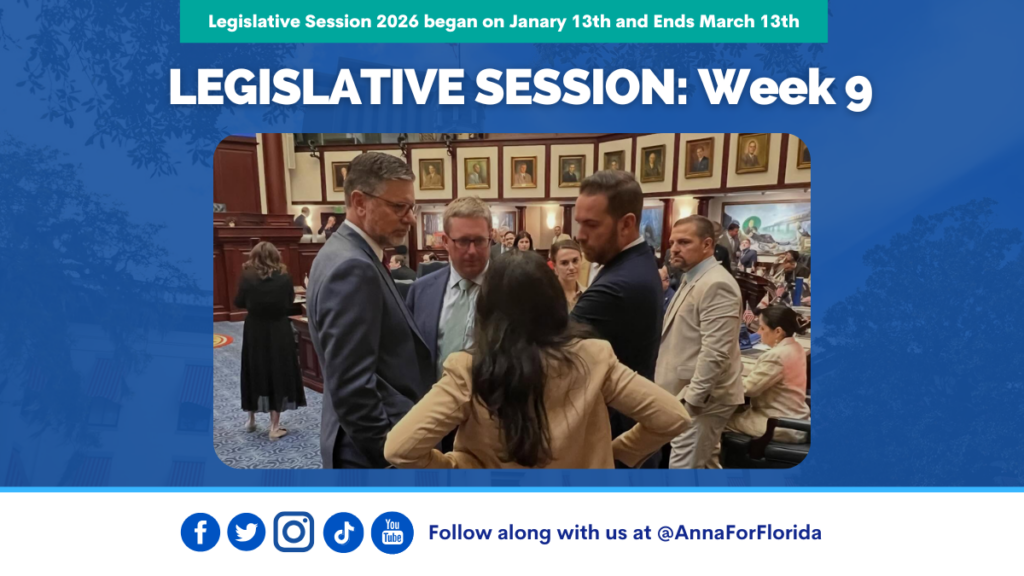
We’ve got lots more details from the final week of session – including the fates of dozens of bills that we debated over the past two months – in our Weekly Update below.
The end of my final regular session is bittersweet. Serving in the Florida House over the past eight years has been the honor of a lifetime. Throughout my time in Tallahassee, I have remained focused on standing up for everyday families, defending our rights, and advocating for policies that improve our community’s quality of life.
I remain committed to ensuring that the voices of our community are heard, both inside and outside the halls of the Capitol. So please be sure to stay connected with us on our social media channels. You can find us on Facebook, Instagram, and YouTube.
Thank you for allowing me to serve.

The final frantic days
As you might imagine, the final week of session is super-hectic. The House and Senate are on the floor basically full-time, either passing bills out and on to the governor or amending them and sending them back to the other chamber as “messages.”
This is what it means when we say that bills are “bouncing” between the House and Senate. And a bill can keep bouncing back and forth until the House and Senate agree on a final version that they can send to the governor – or until the session ends, the bill does.
Probably the best way to begin this week’s update is to quickly run through some of the most important bills that passed. Most of the bills mentioned below passed in the final week, although a few had already cleared the Legislature earlier in session.
A bunch of bad bills passed
We’ll start with the troubling bills that passed. This is – sadly, but probably not surprisingly – a long list:
- House Bill 991 – Elections: Voter suppression bill, requiring more documentation from new voters, voters who update their registration or voters targeted by politicians in Tallahassee and prohibiting university students from using their student IDs when they vote
- Senate Bill 1296 – Public Employee Relations Commission: Union-busting bill targeted at teachers, bus drivers, utility workers and many other public sector workers; raises the threshold needed to win union elections while simultaneously making it harder to participate in union elections
- House Bill 1471 – Systems of Law and Terrorism Organizations: Gives the governor and Cabinet the power to designate advocacy and religious group as “domestic terrorist organizations” and punish people who “promote” them with sanctions such as the loss of scholarships and expulsion from state universities
- Senate Bill 1134 – Official Actions of Local Governments: Anti-DEI bill, preventing local governments from funding diversity programs and cultural events while also giving the governor more power to remove local elected officials from office
- House Bill 1217 – Prohibited Governmental Policies Regulating Greenhouse Gas Emissions: Preempts local green energy laws and other policies enacted by cities and counties intended to reduce greenhouse gas emissions
- House Bill 1451 – Utility Services: Blocks a referendum passed by voters in Gainesville that was intended to restore local control of the city-owned Gainesville Regional Utilities
- House Bill 905 – Foreign Influence: Takes in-state tuition away from international students participating in foreign exchange programs and randomly imposes new restrictions on surrogacy and adoption agreements that were never publicly debated or vetted in a committee
- House Bill 167 – Former Phosphate Mining Lands: Protects Mosaic Co. from lawsuits over radiation exposure on redeveloped phosphate mines
- Senate Bill 1028 – Citizens Property Insurance Corporation: Steers a contract to a vendor run by a Republican megadonor and will lead to some condo and business owners paying higher prices for property insurance
- Senate Bill 7040 – Emergency Preparedness and Response Fund/Executive Office of the Governor: Continues the slush fund the governor used to fund the rushed construction of an immigrant detention facility in the Everglades, although the bill does add a few new transparency requirements
- House Bill 919 – Commercial Service Airports: Strips cities and counties of the power to choose the names of the airports they own. Renames Palm Beach International Airport as “President Donald J. Trump International Airport” – and forces Palm Beach County to enter into a licensing agreement with Trump’s business, which has already trademarked the airport name.
- Senate Bill 182 – Education: A big education package that, among other things, preempts local zoning rules and allows private schools of up to 150 students to open in any commercial or industrial area and to operate inside retail stores, movie theaters, office buildings and other businesses
- House Bill 1279 – Education Another big education package, but this one with another union-busting element in that will let school districts bypass collective bargaining and make unilateral personnel decisions in many more public schools around the state.
- Senate Bill 686 – Agricultural Enclaves Suburban sprawl bill that would allow developers to put more homes on farmland just outside of urban areas
- Senate Bill 628 – Transportation Facility Designations: Renames State Road 80 – 124 miles from Palm Beach to Fort Myers – as “President Donald J. Trump Highway”
- Senate Bill 290 – Department of Agriculture and Consumer Services: The so-called “Farm Bill.” Though it was made better before it passed, the final version still allows the state to sell off public conservation land to private agriculture companies and also preempts local regulations around gas-powered leaf blowers
- House Bill 429 – Criteria for Determining Criminal Gang Membership: Enables prosecutors to claim someone is a member of gang – exposing them to harsher criminal penalties and creating more pressure to agree to a plea deal – in part based the use of “gang-related language” on social media
But some good bills got through, too
It wasn’t all bad news, though. We, as a Legislature, passed a number of positive, bipartisan bills this session, including those around the environment, corporate taxes, and AIDS/HIV medication. I’m also really proud to say that one of the bills I sponsored this session – a bill to prevent drownings of newborn babies and young children – passed, as well, as part of a larger Senate bill.
Here’s a list of some positive bills that passed:
- House Bill 277 – Domestic Violence and Protection Injunctions: Revises several laws related to domestic violence and protective injunctions, including requiring FDLE to enter injunctions against dating and sexual violence into a statewide database, increasing relocation assistance for victims of domestic violence, and adding threats to kill a family pet to the list of factors a judge may consider when deciding whether to grant an injunction
- Senate Bill 302 – Coastal Resiliency: Potentially blocks construction of a proposed cruise port near the Terra Ceia Aquatic Preserve in Manatee County
- Senate Bill 428 – Drowning Prevention: Bill to prevent accidental drownings of newborns and young children, by requiring development and distribution of water- and bathing-safety educational materials
- House Bill 441 – Conservation Lands: Requires state officials to provide more public notice and explanation of proposed sales or swaps or conservation land. Spurred by the governor’s failed attempt last year to give land in the Guana River Wildlife Management Area to a housing developer
- Senate Bill 484 – Data Centers: Strengthens the power of local governments to regulate and control land-use decisions around proposed data centers. This bill was unfortunately watered down before it passed, to remove a provision that would have prevented local government leaders from signing non-disclosure agreements with data center developers. But the final bill is still a good start.
- House Bill 697 – Drug Prices and Coverage: Temporarily blocks cuts proposed by the Trump and DeSantis administrations to the AIDS Drug Assistance Program, maintaining eligibility and funding until the end of the fiscal year
- House Bill 755 – Areas of Critical State Concern: Expands a ban on oil- and gas-drilling around the Apalachicola River
- Senate Bill 1690 – Child Care and Early Learning Services: Makes it harder for property insurance companies to cancel policies covering large family childcare facilities and better aligns training and assessment programs for early learning professionals
- House Bill 7031 – Taxation: “Decouples” from enormous corporate tax breaks in Trump’s “One Big Beautiful Bill Act,” saving $3.5 billion dollars in state money that would have otherwise been given away to the biggest corporations
Bills of concern that we stopped
Of course, a big part of our work in a Legislature that is so gerrymandered – and so much more extremist than Floridians as a whole – is trying to stop bad bills from passing. And we had a lot of success on that front this session.
Here’s a look at some of what we beat back over the past 60 days:
- House Bill 299 & Senate Bill 354 – Blue Ribbon Projects: Would have allowed the largest landowners in Florida to build city-sized developments on rural land without any say from community residents or local elected officials
- House Bill 399 – Rural boundary amendments: Stopped amendments that would have destroyed the rural boundaries in Seminole and Orange counties
- House Bill 945 & Senate Bill 1712 – Statewide Counterintelligence and Counterterrorism Unit: Would have allowed the Florida Department of Law Enforcement to create a state counterintelligence unit with the power to spy on Floridians
- House BIll 1551 & Senate Bill 1748 – Sig Sauer shield: Would have shielded a gun company that made enormous campaign contributions just before session from “ghost firing” lawsuits filed by police officers and others who have been injured by defective guns
- Senate Bill 290 & House Bill 433 – Farm bill “ag gag” provision: Successfully fought to have a provision removed that would have made it much easier for Big Sugar to sue Everglades advocates, public health activists, journalists and anyone else critical of the industry
- Senate Bill 164 & House Bill 289 – Civil liability for fertilized eggs: Would have given fertilized eggs some of the same legal rights as living children and allowed anyone who impregnates someone else to sue over the loss or termination of the pregnancy from the moment of conception.
- Senate Bill 166 & House Bill 173 – “Parental Rights”: Would have prevented teenagers from accessing birth control, treatment for sexually transmitted diseases and non-emergency mental health services without permission from a parent
- House Bill 1071 & Senate Bill 1090 – “Baby Olivia” video: Defeated dangerous language that could have forced public schools to make students watch anti-abortion propaganda produced by an extremist anti-abortion group as part of their health ed curriculum
- Senate Bill 1758 – Medicaid work requirements: Would have imposed unnecessary – and potentially illegal – bureaucratic requirements on the state’s Medicaid program, potentially costing tens of thousands of Floridians their health insurance
- House Bill 917 & Senate Bill 1756 – “Medical Freedom”: Would have effectively undermined school immunization requirements by allowing anti-vaccine parents to opt out for reasons of “conscience” and send their kids to school without any vaccinations at all
- House Bill 221 & Senate Bill 1412 – Minimum wage loophole: Would have created a loophole in the state’s voter-approved minimum wage, allowing employers to pay subminimum wages to some workers
- House Bill 377 & Senate Bill 754 – Philip Morris tax break: Would have exempted Philip Morris’ IQUS “heated tobacco product” from state cigarette and tobacco taxes
- House Bill 1119 & Senate Bill 1692 – Book banning bill: Would have forbidden school districts from considering the literary or artistic merits of books when extremist activists try to have them banned from libraries
- House Bill 1421 – Cows in state parks: Would have allowed the governor to lease land in state parks to private cattle companies for cattle grazing
- House Bill 455 & Senate Bill 496 – Confederate monuments: Would have stopped local communities from removing statues and other memorials to Confederate Army leaders
- House Bill 641 & Senate Bill 1642 – Don’t Say Gay or Trans at Work: Would have made it illegal for state agencies and local governments to require that their employees refer to co-workers by their preferred pronouns and also prohibited many private companies from having employees attend trainings on sexual orientation or gender identity.
- House Bill 743 & Senate Bill 1010 – Anti-Trans Health Access: Would have made it a crime to “aids and abet” a doctor providing gender-affirming care to someone under the age of 18, allowed the attorney general to investigate and prosecute healthcare providers, and enabled parents to sue public school teachers
- House Bill 725 & Senate Bill 1736 – Political activity on college campuses: Would have allowed political appointees of the governor to restrict voter registration drives and other election-related activities on college campuses
- Senate Bill 1236 & House Bill 1387 – ALEC anti-union bill: Would have forced companies that receive economic development incentives to try to stop their workers from joining labor unions
- House Bill 191 & Senate Bill 216 – Florida’s unemployment system: Would have added more bureaucratic red tape and obstacles to obtaining unemployment insurance benefits
- House Bill 663 & Senate Bill 1374 – Abortion bounty bill: Would have put $100,000 bounties on doctors and others who help Florida women obtain abortion medication through the mail
- House Bill 993 & Senate Bill 1044 – IVF restrictions: Would have imposed onerous new restrictions on in vitro fertilization and surrogacy
- House Bill 1487 & Senate Bill 1680 – Anti-family planning legislation: Would have imposed onerous new restrictions on all manner of alternative family planning options, including surrogacy, pre-planned adoption, donor banks, and fertility clinics
- House Bill 443 & Senate Bill 518 – Pesticide legal immunity: Would have insulated pesticide giant Bayer from lawsuits related to Roundup weedkiller
- House Bill 133 – Minimum Age for Firearm Purchase or Transfer: Would have lowered the legal age to buy a gun from 21 to 18, undoing a bipartisan gun-safety reform enacted after the mass shooting Marjory Stoneman Douglas High School
Rep. Eskamani Tries to Address SB180 Mess Faced By Local Governments
You might remember that the Florida Legislature passed a piece of legislation in 2025 known as Senate Bill 180 – an emergency-response and hurricane-recovery bill that barred cities and counties from imposing new restrictions on rebuilding after big storms.
The measure was framed as a way to help homeowners rebuild following major hurricanes. But unfortunately, this language has been exploited by some special interests to significantly restrict local governments’ authority over development approvals and planning decisions. In Orange County, for example, we’ve seen developers try to use SB 180 to undo the voter-approved rural boundary and the community-driven “Vision 2050” comprehensive planning process.
In this session, the Florida State Senate unanimously passed Senate Bill 840, intended to address some of the growth-management problems faced by local governments due to SB 180. But the Florida House did not file any similar legislation.
For that reason, I made two attempts on the House Floor to address this issue – both by way of amendments to House Bill 399. The second attempt came on Day 60 of the session.
Cities and counties across the state have raised serious concerns about how this law has created confusion, exposed communities to litigation, and undermined responsible growth management. House Republican leaders called an informal recess just as I was closing on my amendment – and then came back to rule my amendment out of order. That’s exactly the same ploy they used to avoid voting on my First Amendment rights while attempting to fix SB 180.
Floridians expect us to solve problems — not sidestep them. I will continue standing with our local governments and advocating for the tools they need to plan responsibly for our communities, and I hope future legislators will champion this issue with me.”
The inaugural Iftar Dinner at the Florida Capitol
Amid all the chaos of the last week of session, we were also thrilled to co-host the first-ever Dinner at the Florida Capitol with The Atlantic Institute.
During Ramadan, Muslims fast from dawn until sunset as a practice of reflection, gratitude, and service. Breaking the fast, known as Iftar, is traditionally done in the company of others. It is an act of hospitality; an opportunity to gather, to listen, and to strengthen the ties that bind a community together.
The Wednesday evening event was such a beautiful gathering – a space where people of different backgrounds came together to break bread and build understanding. We’re so grateful to everyone who joined us and helped make the historic evening so special.
Without a budget, what happens next?
You’ve probably heard me say this before: the budget is the one bill that the Florida Legislature is constitutionally required to pass each year. And, of course, we failed to do that during this year’s regular session.
That means we will have to come back to Tallahassee later this spring. Legislative leaders have suggested that they plan to hold a special session on the budget in mid-April. That would put it right around the same time when President Trump wants Republican leaders in Tallahassee to hold another special session to re-gerrymander Florida’s Congressional districts – and make them even more lopsided in favor of GOP candidates – just in time for the 2026 elections.
But as we learned last year, best laid plans can go awry quickly. We also failed to pass a budget by the scheduled end of the session last year. The House Speaker and Senate President chose then to simply extend the session – an extension that was initially only meant to last a few days or weeks, but that ended up continuing for a month-and-a-half. What was supposed to be a 60-day session ultimately dragged on for 105 days, and we didn’t get a new budget done until just a few before the start of the state’s fiscal year, which begins July 1.
It’s important that we all stay on top of this.
There are so many important debates and policy decisions to be had within the roughly $115 billion spending plan itself. But there can also be a dozen or more bills related to the budget – we call them “implementing” and “conforming” bills – that legislative leaders can use to resurrect legislation that seemed to die at the end of regular session.
Not only that, but budget conforming bills can even be used – and have been used in the past – to sneak entirely new proposals into law, without ever putting them through any kind of committee hearing process in which we can study the issue, hear public feedback, and take expert testimony.
So stay tuned for more updates. Our work isn’t done yet.