Dear Friend,
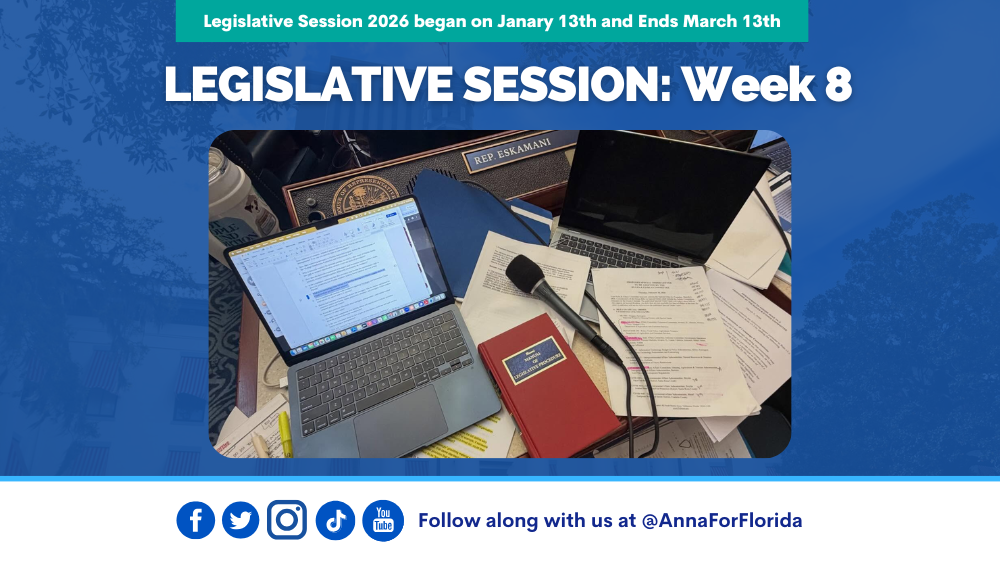
Well, we’ve made it to the final week of the 2026 Session. Or, at least, what was supposed to be the final week of session.
Unfortunately, House and Senate leaders are in a stalemate over the state budget and have yet to even begin the negotiations to resolve the roughly $1.5 billion gap between the two chambers’ proposed spending plans for the 2026-27 fiscal year. That means – barring some unexpected announcement over the next 48 hours – we won’t be able to pass the one bill we are constitutionally required to pass each year by Friday’s scheduled end of session.
We should get an announcement soon from the House speaker and Senate president about next steps, which will likely involve either extending the current session for an indefinite period of time or gaveling the regular session to a close and coming back for a budget-focused special session closer to the beginning of the state’s next fiscal year, which starts July 1.
But this will still be a frenzied and fast-paced week in the Capitol, with votes expected on enormously important bills attacking unions for teachers and other public sector workers; erecting new barriers to voting for young people, women and communities of color; allowing giant landowners to develop rural tracts of land without any input from local residents; and enabling the governor and Cabinet to designate “domestic terrorism organizations.”
The future of the rural boundaries in Orange and Osceola counties could be decided this week. So could the fates of foreign exchange students at Florida universities, community-sponsored cultural festivals across the state, and the decades-long battles to restore Central Florida’s Oklawaha River.
You can read more about all those issues – and many more – in our Weekly Update below.
Stay tuned to our social media channels for further updates throughout the week, from urgent alerts on last-minute amendments to the next steps for the budget and an extended or special session. You can find us on Facebook, Instagram, and YouTube.
Some of the shadiest stuff in Tallahassee always happens during the final week of session. So we all need to stay on high alert.
Onward,

Not again: Another budget impasse means we’re headed for an extended or special session
The House and Senate haven’t yet agreed to a new state budget – which means, for the second year in a row, the Florida Legislature will not finish its work on time.
Technically, we have until Tuesday to finalize the fiscal 2026-27 spending plan, which is the one bill we are constitutionally required to pass each year and which must be done at least 72 hours before we can vote on it.
But that’s simply not enough time. The initial draft budgets passed by the House and Senate are roughly $1.5 billion apart – with important differences across hundreds of different line items – and we haven’t even begun the process of ironing out those differences through what is known as “budget conference.” It would take something truly unprecedented for a budget deal to suddenly come together in time for us to vote on it by Friday, which is Day 60 and is supposed to be the final day of the 2026 session.
The House Speaker and Senate President haven’t yet made a formal announcement. But we’ll either need to extend the session – which is what we did last year when the House and Senate hit a similar budget stalemate – or we’ll need to end session and came back later in the year for a special session focused on the budget, which has to be in place by July 1.
It could be one of at least three special sessions this spring. Gov. Ron DeSantis has already said he wants the Legislature to come back to Tallahassee in April so Republicans can re-gerrymander the state’s Congressional districts before the 2026 elections. We’re also likely to hold another special session on a proposed property tax cut that Floridians would then vote on later in the year via a statewide referendum.
Republican senators block Medicaid expansion
Sadly, the Florida Legislature has once again blocked an effort to expand Medicaid enrollment and provide health insurance to more Floridians.
It happened last week on the floor of the Florida Senate during a debate on Senate Bill 1758, a bill that would impose what supporters like to brand as “work requirements” on some people who currently get health insurance for themselves or their children through Medicaid or Florida KidCare.
Basically, it would require certain groups of people currently enrolled in Medicaid – including single mothers raising teenage kids and people in their 60s who are not yet eligible for Medicare – to work at least 80 hours a month or else they lose their Medicaid coverage.
There are a couple of problems with this. First, as we’ve seen across other states and benefit programs, “work requirements” are often just bureaucratic paperwork requirements that states use to create cumbersome compliance and monitoring processes – which both frustrate people out of seeking benefits in the first place and frequently deny benefits in error to people who are entitled to them.
It’s a scheme we’re all too familiar with in Florida, with our perpetually broken unemployment benefits system.
But more importantly, Florida is one of just 10 states that never expanded Medicaid under the Affordable Care Act. Our eligibility thresholds are already so low: A mother with three kids can’t get Medicaid coverage for herself unless she makes less than about $8,000 a year.
So think about what would happen if work requirements were put in place (and they actually worked as intended): Someone working 80 hours a month at a minimum wage job would now make too much money to qualify for Medicaid in Florida – even though very few minimum wage jobs come with health insurance.
We’d be forcing people into what’s known as the “coverage gap” – where someone makes too much money to qualify for Medicaid in a non-expansion state like Florida but not enough money to qualify for federal tax credits meant to help folks afford coverage on the private market.
To solve this problem, Senate Democratic Leader Lori Berman proposed an amendment to Senate Bill 1758 that would have made the proposed work requirements regime contingent on Florida expanding Medicaid eligibility under the ACA.
Republican senators rejected the amendment on a voice vote.
Senate Bill 1758 hasn’t yet passed the Senate, and there’s not an identical bill in the House yet. But I expect this will be one of those issues that gets negotiated between the two chambers as part of budget talks – whenever those actually begin.
Showdowns over development on rural land
We just had a big showdown over developing rural land in Florida – and more are coming this week.
In the Florida Senate, a bipartisan group of senators rallied to stop the so-called “Blue Ribbon Projects” bill, which would let giant landowners ignore local residents and local elected officials and develop city-like developments on rural tracts of land. The proposal (House Bill 299 and Senate Bill 354) is being pushed by a New York hedge fund manager who owns more than 80,000 acres of land across north Florida, much of it around Jacksonville and St. Augustine.
The fight is not over. The lobbyists behind the Blue Ribbon Projects bill are still working behind the scenes to pick off a few more votes, which is apparently important to Sen. Jim Boyd (R-Bradenton), the incoming Senate president. The Senate could take up the bill again at any time this week.
At the same time, the House last week passed another developer-backed bill that would seriously weaken protections for rural land in places like Orlando and Miami. Among other things, House Bill 399 would override a charter amendment that more than 70 percent of Orange County voters approved in 2024 that requires any request for intensive development on land beyond the county’s “rural boundary” to be approved by a supermajority of the county commission. The bill would lower the threshold to a simple majority of commissioners.
It could get worse, too. House Bill 399 now goes to the Florida Senate, which is expected to take up either it or the Senate companion (Senate Bill 208) on Wednesday. And Sen. Jason Brodeur (R-Sanford) has said he intends to support an amendment that would completely eviscerate the rural boundaries in both Orange and Seminole counties. That could lead to yet another close floor vote in the Senate.
International exchange students and families adopting through surrogacy could be caught up in ‘foreign influence’ bills
A bill that supporters are touting as an effort to stamp out “foreign influence” in our elections has become a really dangerous bill that targets international university students and couples trying to have babies through surrogacy.
While there are some reasonable safeguards in House Bill 905 to address influence operations by hostile nations, the bill also punishes international students from around the world by eliminating in-state tuition for folks enrolled in Florida colleges through linkage programs with overseas universities.
We are each committed to the safety of our state, but this needlessly targets foreign exchange students, limiting their ability to contribute to our higher education institutions and academic research.
Not only that, but the bill was also randomly amended on the House floor to impose new restrictions on surrogacy and pre-planned adoption agreements – language that has never been vetted by experts and really should not be included in this bill.
House Bill 905 passed the House and now goes to the Senate, which has a similar bill (Senate Bill 117) – but which is even worse. The Senate bill has much broader language around surrogacy that could end up blocking even Floridians from using this option to begin or expand their families.
Sweeping preemptions target local climate policies, cultural programs and electric utilities
This has been yet another session in which my colleagues in Tallahassee seem to have decided that they know better than all the independently elected local officials all across Florida.
The Legislature is poised to pass several major “preemptions” of home rule authority. One of the worst is House Bill 1217, which passed the House last week, prohibits cities and counties from adopting or implementing “net zero” or greenhouse-gas reduction policies and also restricts how public funds can be spent on efforts to combat climate change.
While this is being framed as a cost-control measure – Senate leaders have even put this preemption into their proposed tax package – the language is extremely broad and could be used to undermine practical and popular local initiatives around energy-efficient buildings, clean-energy procurements, and participation in regional climate partnerships.
In addition to weakening home rule, this would ultimately undermine common-sense efforts to reduce costs for communities. The many cities, towns, and counties across Florida all face very different environmental and economic realities related to flooding, extreme heat, and storms. House Bill 1217 takes away their flexibility to tackle those problems and replaces it with a one-size-fits-all mandate from Tallahassee.
The Senate could take up the bill this week, or it could also choose to make the issue a part of tax and budget negotiations down the road.
Meanwhile, the Senate passed Senate Bill 1134, a particularly ugly preemption targeting local government initiatives that support women, people of color, LGBTQ+ communities – basically anyone or anything who could be lumped under a “diversity, equity, and inclusion” umbrella.
One of the major problems with this bill – like so many other culture-war bills passed during the DeSantis era – is that it is vague and broad, meaning it could be weaponized to shut down even broad programs that no one ever intended to impact, like cultural festivals and heritage events. And that’s important because the bill also puts local elected officials at risk of being sued by a local resident or removed from office by the governor if they are accused of violating this law.
The House has a similar bill (House Bill 1001) that has yet to pass but could at any day. If this does become law, there is going to be enormous pressure on local elected officials to simply avoid funding anything at all that some fringe extremist could claim is “DEI.”
Unfortunately, that’s not the end of the preemption parade.
On the same day the House passed that anti-climate change preemption, we also passed House Bill 1451. While most of that legislation focuses on policies related to the operation of all local utilities, it also includes a subtle but important section intended to undermine the will of voters in Gainesville – and keep the city’s municipal utility, Gainesville Regional Utilities (GRU), under the control of the governor rather than the local residents who actually own it.
This is part of a years-long battle that began in 2023, when the governor and Legislature decided to seize control of GRU from the city – potentially setting the stage for privatization down the road. Gainesville residents have been fighting to get it back ever since, and I believe firmly that we should respect the will of local voters on this issue.
As Ron DeSantis attacks teacher unions, the Florida Senate passes a union-busting bill
Despite bipartisan opposition, the Florida Senate passed an aggressively anti-union bill last week that would make it harder for most public-sector workers to form unions and collectively bargain for better pay and benefits.
Senate Bill 1296 would impose a bunch of new restrictions on unions, most notably by increasing the threshold by which employees must win elections in order to form or maintain a union, while at the very same time making it more difficult for workers to vote in these elections.
The legislation was initially written by the Freedom Foundation, an organization funded by right-wing billionaires that pushes anti-union legislation across the country. And it is now being pushed in Tallahassee by Gov. Ron DeSantis and the aide he installed as Florida’s Education Commissioner, Anastasios Kamoutsas, who wants to bust Florida’s teachers unions.
Republicans have carefully amended the bill so that it will not affect unions that tend to support them in elections – namely, police and firefighter unions. But it’s also an attack on far more than the teachers’ unions, as it would also curtail the collective bargaining rights of bus drivers, utility workers, sanitation workers, nurses, clerks, and so many other public-sector workers.
Five Republican senators voted against Senate Bill 1296, but it still passed the Senate by a 21-14 vote. It now comes over to us in the House, where we have a very similar bill (House Bill 995).
Donor-backed bill would make some condo and business owners pay *more* for property insurance
It’s important to remember that busting public-sector unions doesn’t just hurt government workers and contractors.
It also hurts private-sector workers. Studies have shown that hourly private-sector workers are paid more and receive better benefits in communities where public-sector workers are highly unionized. That’s because private employers are forced to raise pay and benefit packages in order to compete for labor.
So in that sense, Senate Bill 1296 and House Bill 995 could actually make our cost-of-living crisis in Florida even worse.
And it’s not the only bill that would make life in the Sunshine State more expensive.
The Senate also passed Senate Bill 1028 last week, which would require some condo and business owners to pay higher property insurance premiums.
The bill would force Citizens Property Insurance, our state-run public nonprofit insurer, to start a program through which what are known as “surplus lines’ insurance companies could take over policies covering condo buildings and business properties. Surplus lines insurers are nearly unregulated insurance companies; their rates, for instance, are not all controlled by the state, and they don’t have to comply with basic consumer protections around things like renewal notices.
Under the bill, if a surplus lines insurer offered a policy that was up to 15 percent *more* expensive than a policy offered by Citizens, the condo association or business owner would have to take it. They would become completely ineligible for new or renewed coverage through Citizens.
The Tampa Bay Times reported earlier in the session that this bill is being pushed by a billionaire Republican megadonor who has an insurance-services company – and who wants a contract from Citizens to run this new surplus lines program.
Rewriting the rules ahead of 2026 elections
The Legislature is about to rewrite election rules ahead of the 2026 campaign to help Donald Trump and the Republican Party retain control of government in both Washington and Tallahassee.
The Senate last week passed Senate Bill 620, which would make a bunch of changes to laws around how candidates of office qualify for the ballot. The most important change is that it would delay the qualifying dates for this year’s round of Congressional elections.
Why is that important? Well, the Trump White House wants Republicans in Tallahassee to redraw the state’s Congressional districts this spring to make them even more lopsided in favor of the GOP. They hope to eliminate seats currently held by Democratic representatives in both Orlando and South Florida.
The Legislature needs to push back the qualifying timeline in order to have time to do a new gerrymander.
Senate Bill 620 now comes over the House, which is very likely to pass it this week.
That’s not all. The House also just passed House Bill 725, which would give the governor broad new powers to restrict or block voter-registration drives and other election-related activities on university campuses – an obvious ploy to suppress the vote among young people.
It’s not yet clear if the Senate will go along with that idea. But the Senate is expected to vote Wednesday on an even bigger elections package (Senate Bill 1334 and House Bill 991) that would require Florida voters to prove their citizenship in order to register to vote.
The legislation would require new voters – or already-registered voters flagged by state officials in Tallahassee – to produce documents such as a birth certificate or an active passport in order to register to vote.
There is, of course, no evidence of significant voting fraud in Florida elections. This is purely a ploy to create new bureaucratic obstacles to voting – obstacles that would particularly impact folks like college students who live far from home, women who have changed their last name as a result of marriage or divorce, and elderly Black people who were never issued a birth certificate.
The House version of the bill would go even further in targeting young people by preventing university students from using their student IDs as identification when they show up at their polling place. The Senate bill doesn’t include that provision, but it’s one of the issues likely to be resolved one way or the other this week.
Florida Senate agrees to let the governor designate ‘domestic terrorist organizations’
A controversial bill that would let the governor and Cabinet designate “domestic terrorist organizations” is on the verge of passing, after getting through the Florida Senate last week.
Civil-rights and free-speech advocates have mobilized in opposition to the bill (House Bill 1471), which will almost certainly be used to target Muslim organizations and to take taxpayer-funded vouchers away from students attending Islamic private schools – while, of course, the state of Florida continues to fund vouchers at Christian and Jewish schools.
But it’s the sort of bill that could ultimately be weaponized against any organization disfavored by the governor and Cabinet – where, remember, two of the three current members were appointed by the governor rather than elected by Floridians.
The Senate did make some very slight improvements to the bill, like requiring the state to give an organization advance notice before a vote is taken to designate it a domestic terrorist organization. That means the legislation must come back to the House, where we will have to vote on it again this week before it can pass.
House and Senate wrestle over PreK-12 and higher education packages
A couple of big education bills will be considered on the floor this week.
The Senate will take up the main PreK-12 package on Tuesday (House Bill 1071 and Senate Bill 7036). There are a lot of good proposals in both of these bills – but also some really ugly provisions, particularly in the House bill.
For instance, the House package includes what’s known as a “Baby Olivia” bill, which could basically force Florida public schools to show students an anti-abortion propaganda video produced by an extremist right-wing group as part of their official health education curriculum. The House bill also includes language prohibiting school districts from using funds to support diversity programs or any kind of “political or social activism” – a vague term that the Ron DeSantis-appointed State Board of Education would be free to define however it wants. Neither provision is in the Senate bill.
Then, on Wednesday, the Senate will take up an omnibus higher education package (House Bill 1279 and Senate Bill 7038). The House bill would force the University of Florida and a number of other public universities to cut enrollment of out-of-state students to no more than 5 percent of their freshman classes. It would also restrict the number of international students our universities can admit – and also where they can admit them from.
The Senate doesn’t have those rigid caps in its bill. But both chambers have language in their higher ed packages that would allow state universities and colleges to sidestep independent accreditation agencies and instead obtain accreditation through a politically motivated, politically controlled accreditor that Florida and several other Republican-controlled Southern states are launching.
On the environment: Bills to auction off conservation land, allow cattle grazing in state parks, and restore the Ocklawaha River
Some important bills impacting the environment – both positively and negatively – moved forward last week.
The House passed Senate Bill 290, the so-called “Florida Farm Bill.” It had already passed the Senate, so it now goes to Gov. Ron DeSantis to sign or veto.
The good news here is that a provision that would have enabled Big Sugar to sue environmentalists and journalists was removed from the bill before it passed. The bad news is that the final legislation still includes provisions that would enable the governor to sell off state conservation land to agriculture companies.
The House also passed House Bill 1421, which could lead to private companies grazing cattle in some of our state parks. The Senate hasn’t advanced any similar legislation this session, so hopefully this idea is dead – although, as with every other issue, this is the time of year when we have to be on guard for last-minute amendments.
Finally, the House passed a great environmental bill: House Bill 981, which would lead to the eventual restoration of the Ocklawaha River, which has been blocked for more than 50 years by a dam that was built as part of a barge canal across Florida that was never even completed. This is a big deal for both Central and Northeast Florida, as the Ocklawaha is the main tributary of the St. Johns River, the largest river in the state, and an important ecosystem in its own right.
There’s a similar bill in the Senate, so I’m hopeful this one can get across the finish line this week.
An update on our bills: Drowning-prevention legislation is poised to pass
One of the bills I’m personally sponsoring this session is so close to passing.
House Bill 503 is designed to stop accidental drownings among newborn babies and young children. It would require the Department of Health to develop educational materials on drowning prevention, safe-bathing practices, and the importance of swimming lessons. Those materials would then be provided to hospitals, birth centers, home birth providers, and childbirth educators to distribute to new and expecting parents and other caregivers.
I’m thrilled to report that House Bill 503 passed the House last week with overwhelming bipartisan support. And the Senate has already passed a very similar piece of legislation in Senate Bill 428. So I’m really optimistic that we’ll be able to get these bills completely lined up and sent to the governor
Another bill I’m sponsoring also passed the House unanimously last week: House Bill 423, which would ensure that children who tend to wander off without telling anyone – a common occurrence among children with autism – remain safe at school.
The bill would require public schools to identify teams to develop proactive response procedures for children at risk of elopement that could be activated immediately if the child leaves campus during the school day. The plans would be crafted in consultation with the child’s parents and include a quick-reference guide with crucial details, such as a current photo, the child’s communication abilities and medical needs, and potential locations they are likely to visit.
Sadly, the companion bill in the Senate hasn’t been given any hearings this year. But we’re going to continue advocating for this cause next year, even though we’ll be doing so from outside the Legislature.
Quick-hit updates: AI, guns and vaccines
Finally, quick updates on a few other issues we’ve been monitoring all session:
The Senate passed Senate Bill 482, which would establish new state regulations on Artificial Intelligence, particularly around the content produced by chatbots. The House has yet to hear similar legislation.
The House passed House Bill 1551, which would give legal protections to the gun company Sig Sauer, which is facing lawsuits across the country brought by police officers and others who have been injured when a company-made gun allegedly fired without anyone pulling the trigger. A similar bill has cleared one committee in the Senate, which we could see this pop up somewhere as a last-minute amendment this week.
The Senate heard, although it has not yet voted on, Senate Bill 1756, an anti-vaccine bill being pushed by Gov. Ron DeSantis and First Lady Casey DeSantis. The bill would essentially let parents ignore immunization rules and send unvaccinated children to school simply by claiming to object to vaccines for reasons of “conscience.” House Speaker Danny Perez has said this bill is unlikely to get a vote in the House, though.