Dear Friend
We’re entering the homestretch of the 2026 Legislative Session (sort of).
We just wrapped up the sixth week of what is usually a nine-week session, which means we should be two-thirds of the way through it. Things are a little more unclear this year, though. Continued infighting between Republican leadership in the House and Senate and with Gov. Ron DeSantis has made it look increasingly likely that we may have to extend the 2026 session or come back for one or more special sessions later in the year.
Still, week six is always a big pivot point and this year was no different in that regard. The House and Senate both passed competing versions of the budget last week, setting the stage for the “budget conference” process where we negotiate a final spending plan. The budget negotiations will include some major public policy issues, too – including the fate of the slush fund Gov. Ron DeSantis used to build an immigrant detention facility in the Everglades and New College of Florida’s attempted takeover of the University of South Florida’s Sarasota-Manatee campus.
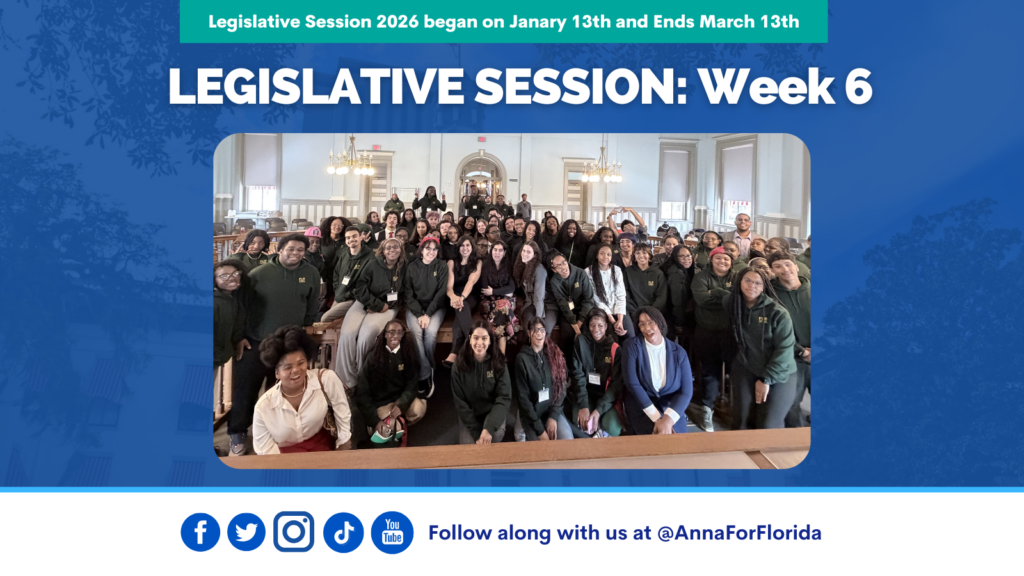
We also finally saw signs of movement in big debates on property taxes and data centers. And while dangerous bills around issues like unemployment benefits and suburban sprawl continue to creep forward, we also scored some really important wins pushing back against anti-abortion extremism and a scheme to let the governor weaponize terrorism laws against domestic political opponents.
You can read lots more about each of those bills – and many more – in our Weekly Update below. And if you’re not already, make sure to connect with us on our social-media channels where we post real-time news and updates throughout the week. You can find us on Facebook, Instagram, and YouTube.
Even though we don’t know exactly how or when the 2026 session will end, the next few weeks are going to be intense. We’ll be spending more and more time in floor sessions, passing dozens of bills – often very quickly and with sudden amendments surfacing at the last minute.
So we’ve got to stay on guard, keep pushing back, and make sure every member of the Florida Legislature knows that we are paying attention.
Onward,

House and Senate pass dueling budgets
The biggest news of the week is that the House and Senate both passed their drafts of the new state budget, which allows us to begin negotiating the final version through a process known as “budget conference.”
The budget is the one piece of legislation that we are constitutionally required to pass each session, and we’re starting conference off pretty far apart. The House budget totals about $113.6 billion while the Senate’s is about $115 billion – a roughly $1.4 billion gap. There are substantial differences in funding for affordable housing, AIDS and HIV medication assistance, and much more.
The House’s first draft of the budget, which is filed as House Bill 5001 and formally known as the General Appropriations Act, is far from perfect. I’m especially concerned by the fact that it eliminates all funding to acquire conservation land through Florida Forever program in favor of easements that keep properties in agricultural production but do not allow for environmental restoration or public access.
But the House budget also provides $100 million for teacher pay raises. It eliminates funding for the so-called “Schools of Hope” charter-school takeover program and for Ron DeSantis’ State Guard. And it dramatically cuts funding for a slush fund the governor has abused to spend hundreds of millions of dollars on lawless immigration enforcement and detention facilities.
So I decided to vote yes on House Bill 5001 – partly to continue these budget conversations in good faith as we enter conferencing.
But I voted no on House Bill 5003, which is what’s known as the “budget implementing bill” because it makes hundreds of changes to state law necessary to implement various funding decisions in the budget.
The problems with this implementing bill are many – starting with the act that it currently has no guardrails around Florida’s universal voucher system, which has drained public education of funding. A recent report from the Office of the Inspector General revealed obvious problems with the way we currently track – or, more accurately, fail to track – these public dollars.
The implementing bill also contains ugly and unnecessary language attacking efforts to support diversity, equity and inclusion. With President Trump’s recent racist and awful post on social media depicting former President Barack Obama and First Lady Michelle Obama as apes, it is important that we acknowledge the realities and continuing impacts of racism, and the lived experiences of Black Floridians.
I have been appointed as an At-Large Member for the budgeting process, and now we wait for conference to begin.
Property tax plans begin to come into focus
The other major story of last week is that we are finally starting to see movement on the property tax debate.
It began in the House, which last week passed House Joint Resolution 203, a proposed constitutional amendment for the 2026 ballot that, if approved by voters, would eliminate all non-school property taxes on homestead properties.
This is a reckless idea that would rip enormous holes in the budgets of every city, county, and town in Florida. It would cost local governments $18 billion a year – even more in the future – forcing both deep cuts in everything from police to parks to pothole-filling and other tax and fee increases. It would also shift the cost of funding these services onto non-homesteaders – including renters. So I voted no.
Fortunately, this proposal will not pass. Because we learned last week, the Florida Senate is not going to go along with the plan to eliminate all non-school property taxes for homestead property and instead intends to propose a much larger homestead exemption. It’s not yet clear if the larger homestead exemption would be based on a set dollar amount or a percentage of assessed value.
Obviously, we still need to see the details. But this would at least be a better approach. Still, we need to be very careful that we’re not creating a “Fee State of Florida,” where every day, people end up paying more out-of-pocket for basic government services while local communities lose critical funding for infrastructure, public safety, and quality of life.
If we’re not thoughtful and careful here, Florida’s property tax “reform” could actually make everyday life more expensive for Floridians, not less.
I should also note that the House also passed House Bill 103, which would force cities and counties to eliminate all their local business taxes. The Revenue Estimating Conference, this would wipe out nearly $200 million in local government revenues, on top of whatever property tax cuts the Legislature ultimately passes. That’s just irresponsible.
It would also result in a tax shift, with business-related municipal services paid for by residents instead. We need to remember that a balanced tax structure is important, both because it diversifies revenue sources and because it ensures that every stakeholder contributes to the community collectively.
This bill erodes that balance.
Big wins on free speech and reproductive rights
We had a couple of really big wins last week that serve as an important reminder of how meaningful grassroots activism and organizing are – even in the Florida Legislature.
A Senate committee was supposed to hear Senate Bill 1632, an incredibly dangerous bill that would give the governor to designate ideological groups he does not like as “domestic terrorist organizations.” But after an enormous outpouring of opposition, the chair of the Senate Criminal and Civil Justice Appropriations Committee was forced to postpone the hearing on the bill. And when we get this late in the session, every day delay is a big deal
At the same time, a scheme to slip an anti-abortion bill into another bill in the Senate failed.
Sen. Erin Grall (R-Vero Beach) is sponsoring the Senate version of an unhinged bill that tries to give fertilized eggs some of the same legal rights as living children, and that would ultimately enable abusers to harass women who lose their pregnancies or seek abortions. But her bill (Senate Bill 164) is stuck in committee. So she tried to have it amended unto a completely unrelated bill during a meeting last week of the Senate Rules Committee.
Fortunately, Senate Democratic Leader Lori Berman was ready and was able to block the move because it was a blatant violation of legislative rules, which require that amendments be “germane” to the underlying bill they would be attached to.
That said, as big as these wins were, neither battle is over. The Senate Criminal and Civil Justice Appropriations Committee has put the terrorism bill back on its agenda for this week, and it is almost certain that we’ll see more efforts to sneak extremist anti-abortion language into other bills via amendments. So we have to stay on guard and keep on pushing back until the session officially ends.
Shutting down the governor’s slush fund: Two steps forward, one step back
There was some good news and bad news on immigration policy last week.
The bad news is that the House leaders backed down from a plan to forbid Gov. Ron DeSantis from using an emergency response fund, which was supposed to be spent responding to natural disasters like hurricanes and floods, on anti-immigrant harassment, publicly stunts, and no-bid contracts.
The House instead rewrote House Bill 5503 to let the governor continue using this emergency fund for immigration enforcement, but with a provision that would at least require him to tell the Legislature exactly how he plans to spend this money in advance and enable legislative leaders to object. House Republicans then rejected amendments offered by Democratic members, including two I proposed – one that would have prohibited the governor from spending these hurricane recovery funds on immigrant detention facilities specifically, and another that would have at least required the governor to allow lawmakers to visit and inspect these facilities.
But even still, I decided to vote for House Bill 5503. Is it perfect? No. But it is better than where we started, and it moves us closer to restoring accountability, transparency, and fiscal discipline with the Executive Office of the Governor. It also includes some other important protections – like reining in the unchecked use of prolonged emergency declarations.
In divided government, progress often comes in increments. I voted for the bill because it improves the status quo, adds meaningful guardrails, and puts us on a better path toward responsible governance in states of emergency.
Bills continue the politicization of higher ed
As part of the budget, the House also passed House Bill 5601, which would allow New College of Florida to take over the University of South Florida’s Sarasota-Manatee campus. I voted no on this giveaway to New College, which has become the most irresponsible public institution in the entire state of Florida.
USF’s regional campuses are part of a high-performing, nationally recognized university system that serves thousands of students and the broader Tampa Bay region. New College, by contrast, has experienced a dramatic decline in tuition revenue, rising per-student costs, and increased reliance on taxpayer funding. It is now the most inefficiently run and wasteful public university in Florida – by a mile. We are currently spending almost four times as many students at New College as we are throughout our state university system as a whole.
Shifting part of USF to New College raises serious concerns about governance, financial sustainability, and the potential disruption to students. Major structural changes to successful institutions should be driven by clear academic and financial benefits, not uncertainty or politics.
In another concerning development on the higher education front, the Senate Education PreK-12 Appropriations Committee passed Senate Bill 7038.
This omnibus education package includes a provision that would severely erode academic independence and freedom at Florida’s universities. Specifically, it would enable the state universities to abandon independent accreditation and instead get their accreditation through a state-controlled accreditor that Florida is launching, known as the Commission for Public Higher Education.
Spending taxpayer money to support yet another Trump grift
In a session where Republican leadership in Tallahassee can’t seem to stop fighting with each other, they managed to come together one issue: Enabling another Trump family grift.
The House and Senate both passed House Bill 919, which would force Palm Beach County to rename Palm Beach International Airport as “President Donald J. Trump International Airport” – to enter a licensing agreement with one of Trump’s businesses, which just trademarked the airport name.
Before passing the bill, Republicans rejected Democratic amendments that would have ensured neither Trump nor his family nor his businesses could profit from this name through things like royalties and merchandise sales. We should be especially wary of this kind of profiteering because the Senate budget proposes spending millions of dollars of taxpayer money to make this name change happen, from hanging new signs at the airport to designing new logos for merchandise, which would make these trademarks even more valuable for Trump.
And what may be even worse, this legislation also strips the cities and counties that own Florida’s big airports – including the city of Orlando, which owns Orlando International Airport – of the power to choose their airport’s names.
But even aside from the potential for corruption or the heavy-handed preemption, I voted no for the simple reason that I don’t believe we should name major public facilities after deeply divisive political figures.
Airports serve everyone, regardless of party. They should be symbols of shared civic identity, not political division.
Laid-off workers in Florida could face even more obstacles to unemployment benefits
As we get deeper into session, we are spending more time in floor sessions voting on bills on final passage.
One bill in particular I want to flag is House Bill 191, which passed the House last week and would create even more administrative burdens on Floridians seeking unemployment benefits – benefits they have already paid into and earned through their work.
We already know that Florida’s unemployment insurance (UI) system is one of the most difficult in the country to navigate. Through my direct work helping constituents access their benefits, I have seen firsthand the unnecessary barriers, delays, and technical failures that prevent eligible Floridians from receiving the support they deserve. Adding more red tape will only make a broken system worse.
My PhD dissertation from UCF focused specifically on Florida’s unemployment insurance system, examining how policy design and administrative hurdles impact access to benefits. The research is clear: when we create more procedural obstacles, fewer eligible people are able to access the assistance they are entitled to receive. That does not protect taxpayers—it undermines workers. Instead of imposing new burdens, we should be modernizing the system, improving access, and ensuring accountability so that when Floridians lose their jobs through no fault of their own, the safety net they paid into is actually there for them.
Obviously, I voted no.
Positive steps in the Senate: Improving the farm bill and undoing some of the damage of SB 180
The Senate spent quite a bit of time on the floor last week, too.
Among the bills the Senate passed was Senate Bill 290, which supporters are calling the “Florida farm bill.” This legislation has been dramatically improved since it was first filed – especially with the removal of language that would have made it easier for Big Sugar to sue people for defamation – but it still contains some concerning language that could lead to conservation lands being sold off to agricultural companies.
We’ll be hearing the House version of this bill (House Bill 433) next week in the House State Affairs Committee, where I serve as ranking member.
The Senate also passed an important piece of legislation in Senate Bill 840, which would roll back some of the overly bad land-development preemptions that were in last year’s Senate Bill 180.
Senate Bill 180 was supposed to be a bill to help communities rebuild after hurricanes, but it has been weaponized by developers and the DeSantis administration to unravel important environmental protections for wetlands and rural lands. Senate Bill 840 would undo some of that damage.
Unfortunately, there’s no similar bill in the House right now, though I’m still hopeful the two chambers can come together on this issue.
‘Blue ribbon’ mega-developments inches forward
The so-called “Blue Ribbon Projects” bill keeps inching forward.
This is legislation that would let the largest landowners in Florida – people and companies that own 10,000 acres of land or more – get their land rezoned for mega-developments without ever going through a vote before the local county commission or town council. The House version is House Bill 299, and it passed the House Commerce Committee last week.
Both the House bill and the Senate version (Senate Bill 354) still have one more committee to go in each chamber.
Another bill pushed by developer lobbyists, House Bill 691, passed the House State Affairs Committee last week. This legislation would make it easier for homebuilders to put new subdivisions on rural land if part of the property is next to another parcel that has already been developed or is already zoned for future development. I voted no.
House leaders have an anti-police bill to protect a gun company on the fast track
The full House of Representatives is now ready to vote on a bill that would shield gunmaker Sig Sauer from civil lawsuits brought by people injured when one of the company’s guns allegedly goes off without anyone pulling a trigger.
At least two juries have held Sig Sauer for making defective firearms and ordered the company to pay millions of dollars to victims of these “ghost firing” accidents. But House Bill 1551 would make cases like these much harder to win.
The legislation passed the House Judiciary Committee last week, even though police officers, who represent many of the victims in these accidents, continue to testify against it. House leadership has fast-tracked the bill this session – while most bills have to go through at least three committee hearings, the Sig Sauer bill was only assigned to two – which means that House Bill 1551 can now get a full floor vote in the House.
Election suppression bills target college students, women and elderly people of color
It’s looking increasingly likely that the Legislature is going to pass yet another bill intended to suppress the vote among certain communities that Tallahassee Republicans don’t like.
The Senate Transportation, Tourism and Economic Development Appropriations Committee last week passed Senate Bill 1334, which will require Florida voters to prove their citizenship by producing copies of documents like a birth certificate or an active passport when they register to vote – or when state officials flag them in the system as potentially ineligible voters.
This is actually a lot like the unemployment bill in that it’s more about imposing administrative burdens on people than protecting against election fraud, which is nearly non-existent on any kind of meaningful scale. And it is targeted at populations like students, women, and elderly people of color – the people who are most likely to have trouble producing sufficient documentation because of challenges of geography, name changes, and historic racism.
The House version of this bill (House Bill 991) is even worse. Among other things, it would strip college students of the right to use their university IDs as identification when they vote, which is nothing more than a naked attempt to stop young people from voting.
House Bill 991 will also be heard on the House floor next week. We’ll be ready and waiting.
Division, distraction and destruction
A number of ugly and divisive bills intended to harm vulnerable communities kept moving forward last week. Among them:
- House Bill 455 would stop local communities from removing public memorials honoring Confederate Army leaders and other supporters of slavery. It passed the House Judiciary Committee, although the Senate version of the bill (Senate Bill 496) hasn’t moved yet.
- House Bill 641 is yet another ‘Don’t Gay or Trans’ bill. This legislation would forbid public employers from requiring that employees address each other by their preferred pronouns and block private employers from requiring that employees attend sensitivity trainings on sexual orientation or gender identity. It also passed the House Judiciary Committee. The Senate version (Senate Bill 1642) has cleared one committee so far.
- House Bill 743 would criminalize therapists, pharmacists, and anyone else who allegedly “aids and abets” a healthcare practitioner providing gender-affirming care to someone under the age of 18. The bill would also empower the attorney general to investigate and prosecute healthcare providers under the law. It, too, passed the House Judiciary Committee. The Senate version (Senate Bill 1010) has passed one committee, although there are substantial differences between the two bills.
- Senate Bill 1134 would forbid local governments from supporting diversity, equity and inclusion efforts. Not only that, but the bill would give extremist activists the power to sue elected officials who they claim violate this law – and the governor the power to remove them from office. This bill passed the Senate Rules Committee and is now ready for a full vote in the Senate. The House version (House Bill 1001) has passed two of three committees, which means this legislation is getting very close to passing.
- Senate Bill 174 would name a road in Miami after Charlie Kirk, the intentionally inflammatory podcaster and MAGA influencer who was tragically murdered last year but also had a history of despicable comments about Black and LGBTQ+ people. The bill passed the Senate Transportation, Tourism and Economic Development Appropriations Committee last week and is already scheduled to be heard in its third and final Senate committee this week. The House version of the bill (House Bill 33) – which would also rename a road in Broward County after President Donald Trump – will be heard on the floor of the House this week.
Late movement on data center regulations
At long last, we’re seeing movement on bills that would impose some stronger regulations on data centers.
The Senate has been moving a bill all session, and it continued to do so last week, when Senate Bill 484 passed the Senate Rules Committee. Among other things, the bill would set new rules around electricity usage – and how the costs of providing that electricity are or are not passed on to other ratepayers – as well as water consumption and public disclosure.
The House has an even stronger bill in House Bill 1007, but it has not moved all session. That will finally change this week, as the bill is set to be heard in the House State Affairs Committee, although the legislation looks likely to be watered down some.
A good-governance trade proposal
Finally, I wanted to end this week by highlighting a few good governance bills that are moving this session – sort of.
The House is moving two really great pieces of legislation on this front. One is House Bill 437, which would add some teeth to the state’s public records law and force the governor to begin responding to records requests in good faith or face real consequences. It passed the House Justice Budget Committee last week.
The other is House Bill 593, which would significantly strengthen state anti-corruption laws intended to prevent state officials from using their offices to interfere with elections.
This legislation would also reform laws around things like legal settlements to prevent abuses like we saw in the Hope Florida scandal, in which Gov. Ron DeSantis and then-Chief of Staff James Uthmeier oversaw a scheme in which $10 million was taken from a legal settlement with a Medicaid money and turned it into funding for political campaign ads. It passed the House State Affairs Committee last week.
There are similar bills in the Senate (Senate Bill 770 and Senate Bill 802). But neither bill has yet received a single hearing this session. But the Senate just passed Senate Bill 1120, a priority for Senate President Ben Albritton that would implement transparency reforms at water management districts. The House version of this bill (House Bill 701) hasn’t moved, either.
Perhaps there’s a good government trade to be made here? Time will tell.