Dear Friend,
We are almost halfway through the 2026 Legislative Session (assuming we actually finish on time this year, of course).
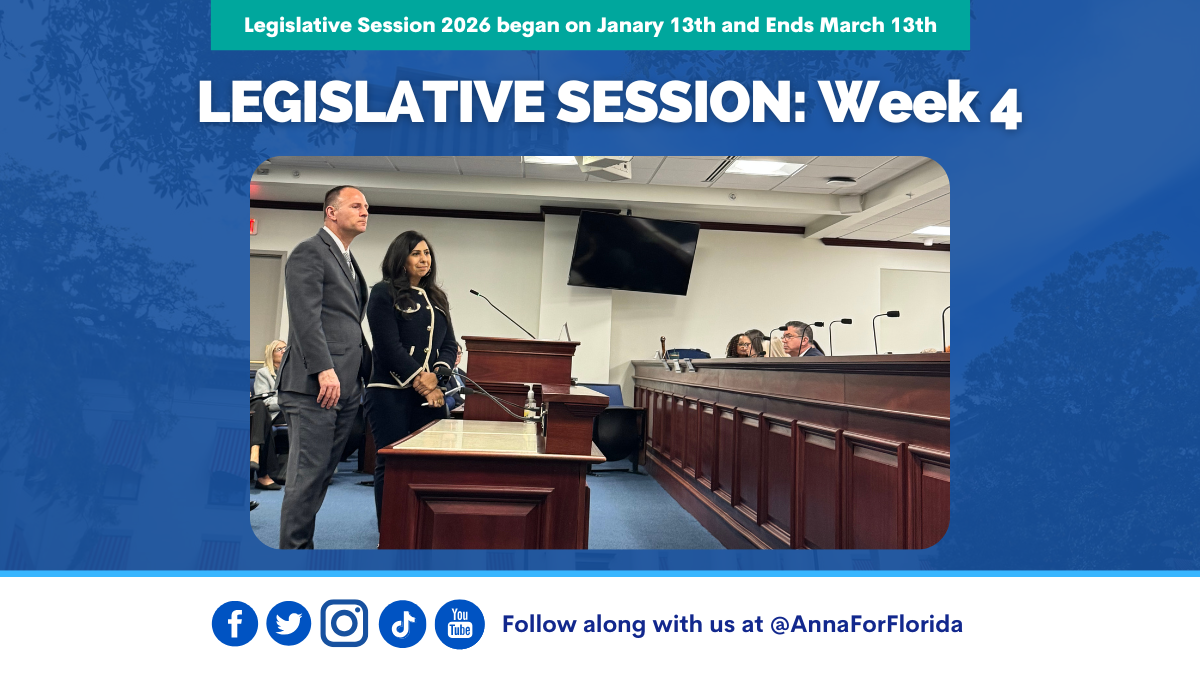
Last week was the fourth of nine weeks in the regular 60-day session. And the schedule was packed: Legislative leaders started moving bills that would kick tens of thousands of working people off of Medicaid health insurance and allow Gov. Ron DeSantis to keep spending hundreds of millions of dollars from the slush fund he abused to build an immigrant detention facility in the Everglades.
A number of really dangerous bills continued moving through committees, too, including ones that would let the governor’s administration designate “domestic terrorist organizations” and undermine the rural boundary charter amendment in Orange County that passed in 2024 with more than 70 percent support. We also saw committees approve bills making it easier for the sugar industry to sue environmental groups and wellness influencers, and immunizing a German gun company against lawsuits over a gun that keeps injuring people when it “ghost fires.”
There was some positive progress, too, including a unanimous vote on a bill I’m sponsoring to protect children with autism while they are at school.
We have updates on all those bills and many more in our Week Four update, available below.
Week Five is going to be even busier: The House and Senate are expected to begin rolling out their proposed budgets this week, so we should get a better idea of whether the session is on track to end as scheduled on March 13 – or if we’re going to have to extend the session or come back for a special session in the spring. Please keep in touch through our social media channels: Facebook, Instagram, and YouTube.
Onward,

Senate unveils plan that could kick many working-class Floridians off Medicaid
Now that we’re about halfway through the Legislative Session, some of the biggest issues are coming into focus. And there may not be a more important one this year than the attempt we are witnessing to take health insurance and food assistance away from tens of thousands of working-class Floridians – and maybe even more than that.
It’s happening through proposals like Senate Bill 1758, which passed the Senate Health Policy Committee last week. The bill would impose something that supporters like to brand as “work requirements” on more than 100,000 Floridians who currently get their health insurance through Medicaid
But these are really work-reporting requirements or paperwork requirements – and they are a scheme we’ve seen used in other states to use intentionally complicated bureaucratic hurdles to deny people access to critical safety nets like Medicaid and the Supplemental Nutrition Assistance Program, better known as SNAP.
Work requirements don’t lead to non-working people on Medicaid and SNAP finding jobs. They lead to people who are already working losing their Medicaid and SNAP. And they usually end up making a lot of money for a few vendors who get contracts to administer the work-reporting programs.
We’ve all seen this exact strategy of weaponizing red tape – academics call it “administrative burden” –used to deny working-class Floridians access to unemployment insurance when they lose their jobs through no fault of their own.
Senate Bill 1758 would also impose additional obstacles for SNAP. And the House is moving similar bills – House Bill 693 and House Bill 1453 – that would cut people off from these critical safety net programs.
Should Ron DeSantis get to keep his anti-immigrant slush fund?
Republican leaders in the Florida Senate rolled out a plan last week to let Gov. Ron DeSantis continue using the no-strings-attached slush fund he used to build an immigrant detention facility in the middle of the Florida Everglades.
This involves an emergency management trust fund that the Florida Legislature created a few years ago (which I opposed), enabling the governor to spend billions of dollars without legislative oversight. It was intended to help the governor and the state’s Division of Emergency Management respond more swiftly and efficiently to natural disasters such as hurricanes.
But the governor immediately began abusing it by declaring a state of emergency over immigration – an “emergency” that he has continually extended for nearly three years now – and using the funds to award no-bid contracts to donors and pay for disgusting, and probably illegal, projects like the Everglades prison camp.
This slush fund is supposed to expire this year. But Senate Bill 7040, which passed the Senate Appropriations Committee last week, would extend it through the end of 2027.
Keeping our kiddos safe: Elopement prevention and safe-bathing education
I’m excited to share that our bill to help keep students with autism safe at school passed its first committee last week.
House Bill 423 would require every public school to designate a School Staff Assistance for Emergencies (SAFE) Team that would be activated if a student were to wander off campus during the school team. SAFE Teams would then develop proactive elopement plans in coordination with the parents of students at risk of elopement, along with quick-reference guides for use if an elopement occurs. The guide would include information such as a current photograph, the child’s communication abilities, key medical considerations, and potential locations the student might visit.
House Bill 423 is a bipartisan bill being co-sponsored by Rep. Chase Tramont (R-Port Orange). It passed the House Student Academic Success Subcommittee unanimously.
I’m also sponsoring a bill this session to help protect children from accidental drownings. The legislation would require the Department of Health to develop educational materials on safe bathing practices and drowning prevention, and to ensure that hospitals, birth centers, and home birth providers distribute those materials to new parents and caregivers of newborns.
And while my bill hasn’t moved yet, the Senate version of the bill – Senate Bill 606, sponsored by Sen. Carlos Guillermo Smith (D-Orlando) passed the Senate Health Policy Committee last week by a unanimous vote.
A House bill would undermine the rural boundaries in Orange and Seminole counties
A measure that would undermine rural boundaries in Orange and Seminole counties continues to advance in the Florida House.
The language is in House Bill 399, and it would preempt any provision of a county charter that requires a comprehensive plan amendment to be approved by a supermajority vote of the local county commission. Instead, counties would have to approve any comp plan amendment that gets a simple majority vote.
The change would eliminate the key safeguards for undeveloped land in a rural boundary, which are designed to make it more difficult for developers to build suburban sprawl housing. HB 399 passed the House Housing, Agriculture & Tourism Subcommittee last week.
A number of other development bills continued advancing last week, too, including:
House Bill 691, which would make it easier to build housing on agricultural land. It passed the House Housing, Agriculture & Tourism Subcommittee.
House Bill 927, which would require local governments to allow developers to hire private consultants to perform reviews of development applications and building permits. It passed the House Intergovernmental Affairs Subcommittee.
House Bill 1139, which would impose more restrictions on cities and counties that want to raise impact fees on new housing construction. It passed the House Housing, Agriculture & Tourism Subcommittee.
A concerning criminal legal bill
The Florida House of Representatives passed what I think is a really concerning criminal justice bill.
House Bill 429, would give prosecutors more ways to claim that someone charged with a crime is a member of a criminal gang. For instance, as evidence that someone is a gang member, they could cite social media posts that use “gang-related language” or rely on testimony from another defendant claiming that someone is part of their gang.
My concern here is that these are both very vague and inherently unreliable standards – and that the threat of being designated as a gang member, which comes increases the potential prison sentences and financial penalties, will be used to pressure young people into pleading out to crimes they may not actually have committed.
Still, HB 429 passed the House by a 100-7 vote. It has not yet passed the Senate.
A few other criminal legal system bills to note:
House Bill 627, which would allow law enforcement officers to refuse to accept public records requests while they are in the middle of a law enforcement activity, passed the House Criminal Justice Subcommittee
House Bill 1455, which would guarantee gun owners the right to a public defender when they respondent in a risk protection order sought by law enforcement, also passed the House Criminal Justice Subcommittee
Senate Bill 1544, would prevent people from filing anonymous complaints against police or corrections officers unless they have corroborating evidence, and passed the Senate Criminal Justice Committee
Siding with a gun company over police officers
Some of my Republican colleagues are pushing a really ugly anti-police bill this year.
It’s House Bill 1551, and it’s designed to protect one big gun manufacturer – German-owned Sig Sauer – from a bunch of lawsuits it is facing across the country, brought by people who suffered gunshot wounds when one of the company’s handguns allegedly fired without anyone ever pulling the trigger.
Many of the victims in these “ghost firing” accidents have been police officers. The sheriff of Indian River County even drove to Tallahassee to testify against this bill, noting that one of his deputies is among those injured by a misfiring Sig Sauer pistol.
But Sig Sauer made hundreds of thousands of dollars in campaign contributions just before the session began. And its bill passed the House Civil Justice & Claims Subcommittee last week.
The Senate version of this bill – Senate BIll 1748 – will get its first hearing this week.
A Big Sugar poison pill in the “Farm Bill”
Another big battle has erupted over the “Florida Farm Bill.”
This is an omnibus package pushed by Republican Agriculture Commissioner Wilton Simpson, but it includes a poison pill: A provision that would make it easier for Big Sugar and other agricultural corporations to sue advocacy groups, news organizations, and other activists who “disparage” any of the food they produce or any of the practices they use.
It’s an obviously anti-First Amendment bill that is meant to help large corporations use the threat of lawsuits to silence anyone who criticizes them over issues related to public health and environmental contamination. And it has spurred an angry backlash from conservationists, fishing guides, wellness influencers, and Make America Healthy Again activists.
Despite the bipartisan groundswell against it, House Bill 433 still passed the House Agriculture & Natural Resources Budget Subcommittee last week.
A couple of other notable environmental bills – two good, the other bad – also moved forward last week:
House Bill 1217, another climate change denialism bill that would block local governments from pursuing green energy and net zero policies, passed the House Economic Infrastructure Subcommittee
House Bill 981 and Senate Bill 1066, which would set in motion the removal of an old dam and the restoration of the Ocklawaha River, passed the House State Affairs Committee and the Senate Agriculture, Environment and General Government Appropriations Committee, respectively.
A billionaire is behind an insurance bill that could lead to higher prices for condo owners
A new investigation by The Tampa Bay Times just revealed that a billionaire Republican megadonor is behind bills moving quickly through both the House and Senate that could lead to many Florida condo owners paying higher prices for worse property insurance.
The bills are House Bill 943 and Senate Bill 1028, and they would require that Citizens Property Insurance Corp., our public nonprofit insurer, create a clearinghouse through which largely unregulated insurance companies could take over policies covering condo associations and other commercial property owners who are currently covered through Citizens.
This would be the first time we’ve ever allowed what are known as “surplus lines insurers” – a type of insurance company whose rates aren’t regulated by the state – to take policies out of Citizens.
That’s alarming enough on its own. But these bills would also allow Citizens to award a no-bid contract to a vendor who would administer this clearinghouse program. And wouldn’t you know it: A billionaire who owns a company that wants the contract – and that has made enormous campaign contributions – is lobbying for the legislation.
The House and Senate bills passed committees last week: HB 943 cleared the House Insurance & Banking Subcommittee, while SB 1028 went through the Senate Agriculture, Environment and General Government Appropriations Committee.
Ron DeSantis wants to publish his own textbooks
The DeSantis administration has another unhinged education idea: It wants to publish its own text books.
A new bill was introduced in the Senate last week to repeal a law that prevents the Florida Department of Education from entering the textbook publishing business.
We’ve already seen numerous examples of the DeSantis administration and his political appointees at DOE and the State Board of Education pressuring private textbook publishers to censor uncomfortable history and insert pure propaganda into instructional materials. But this idea goes well beyond even that level of government interference in academia.
Fortunately, almost everybody, Republicans and Democrats alike, on the Senate Education PreK-12 Committee seemed to agree that this is a dangerous idea, even though they still passed Senate Bill 7036 through its first stop.
In other education news, the House passed House Joint Resolution 583, a proposed constitutional amendment that would erode the separation of church and state in public schools by codifying laws around things like prayer in school.
The Senate version of the legislation, Senate Joint Resolution 1104, passed the Senate Education PreK-12 Committee. If both chambers pass the legislation, the amendment would go on this year’s November ballot.
Meanwhile, the House Education Administration Subcommittee passed House Bill 833, which would make it much easier for small private schools – with 150 students or fewer – to open up in just about any commercial area, including inside retail stores, day cares, and other businesses.
A bill to designate “domestic terrorist” is moving quickly through the Capitol
I’ve been asked by several people whether it’s really true that there is a bill in the Legislature that would let the governor label groups “domestic terrorist organizations.”
Not only is it true – the bills are moving very quickly.
The Senate Judiciary Committee passed its version of the bill (Senate Bill 1632) last week. And the House Education & Employment Committee will hear the House version (House Bill 1471) on Tuesday.
This legislation –which would let a governor label a group “terrorists” and impose sanctions on them before they even have a chance to rebut the designation in court – would be a dangerous idea even in normal times. But it’s especially reckless right now, when we have the Trump administration tarring peaceful protestors as “domestic terrorists” to justify their murders by federal agents.
Data center regulations in the works
The Senate Community Affairs Committee passed Senate Bill 484, which would impose new regulations on data centers. Among other things, the legislation would require the Public Service Commission to develop rules ensuring that data centers bear the entire cost of their own electricity consumption and that other ratepayers aren’t forced to subsidize them.
Unfortunately, the committee also passed Senate Bill 1118, which would create a public records exemption for data centers that would allow developers to have their development applications and other records sealed from the public for up to one year.
The House has its own big data center bill – House Bill 1007 – that would prohibit tax incentives for data centers. That bill hasn’t been given a hearing yet.
Union-busting 2.0 (and 3.0)
There are a couple of union-busting bills on the move.
The big one is House Bill 995, which passed the House State Administration Budget Subcommittee last week. It would impose a host of unnecessary and intentionally onerous rules and regulations on most public sector unions, including requiring employees who want to unionize to win votes by a majority of all employees covered by the union, rather than a majority of the employees voting in the election.
Make no mistake: This is meant to strip many of our public employees – teachers, cafeteria workers, utility lineworkers, sanitation workers and more – of the power to collectively bargain for better pay and benefits. And you can tell that’s the goal because the Republican legislators sponsoring it made sure none of these changes apply to unions representing police officers and firefighters, because those unions tend to be more supportive of Tallahassee Republicans.
At the same time, committees in both the House and Senate passed a bill that would force companies that get tax incentives and public grants to have anti-union workplaces, including forbidding their management from voluntarily recognizing a new union or even from agreeing to be neutral in a union certification election. These are carbon companies of legislation being peddled by the American Legislative Exchange Council, a corporate-funded “bill mill” that pushes anti-worker and anti-environment proposals in state Capitols around the country.
The House version of this copycat legislation, House Bill 1387, passed the House Housing, Agriculture & Tourism Subcommittee. The Senate version, Senate Bill 1236, passed the Senate Commerce and Tourism Committee.
Culture-war attacks…
Of course, we continue to see more ugly attacks targeting LGBTQ+ folks, people of color, and women, plus intentionally inflammatory bills meant to divide and distract.
For example, House Bill 641 and Senate Bill 1642 criminalize basic politeness and decency by prohibiting local governments from requiring employees to use each other’s preferred pronouns. The bills, which passed the House Government Operations Subcommittee and the Senate Governmental Oversight and Accountability Committee, would also make it illegal for private companies to require their own workers attend sensitivity trainings on sexual orientation or gender identity.
There are also House Bill 1001 and Senate Bill 1134, which would prohibit local governments from supporting diversity initiatives and would give the governor the authority to remove from office any local elected officials who vote in favor of such programs. The bills passed the House Intergovernmental Affairs Subcommittee and the Senate Community Affairs Committee.
Meanwhile, the House Health Professions & Programs Subcommittee passed House Bill 743, which would expose therapists, pharmacists, and others to criminal charges for “aiding and abetting” a healthcare provider providing gender-affirming care to minors.
And the House Commerce Committee passed House Bill 919, which would strip the cities and counties that own Florida’s major airports of the power to name them – and then force Palm Beach County to rename its airport after President Donald Trump.
…Corporate favors
While legislative leaders are advancing those intentionally inflammatory culture war fights, they are also pushing many corporate favors. Among them:
House Bill 103, which would eliminate all local business tax charges by cities and counties. It passed the House State Affairs Committee
Senate Bill 216, which would impose even more bureaucracy and red tape on workers trying to claim unemployment benefits. It passed the Senate Fiscal Policy Committee.
House Bill 221, which would let companies ignore the state minimum wage and pay less money to interns and apprentices. It passed the House Careers & Workforce Subcommittee.
House Bill 377, which would give a tax break to Big Tobacco giant Philip Morris. It passed the House Industries and Professional Activities Subcommittee.
Senate Bill 838, which would let car companies charge extra fees when consumers pay car payments by credit card or electronic payment systems like Zelle and Venmo. It passed the Senate Banking and Insurance Committee.