Dear Friend,
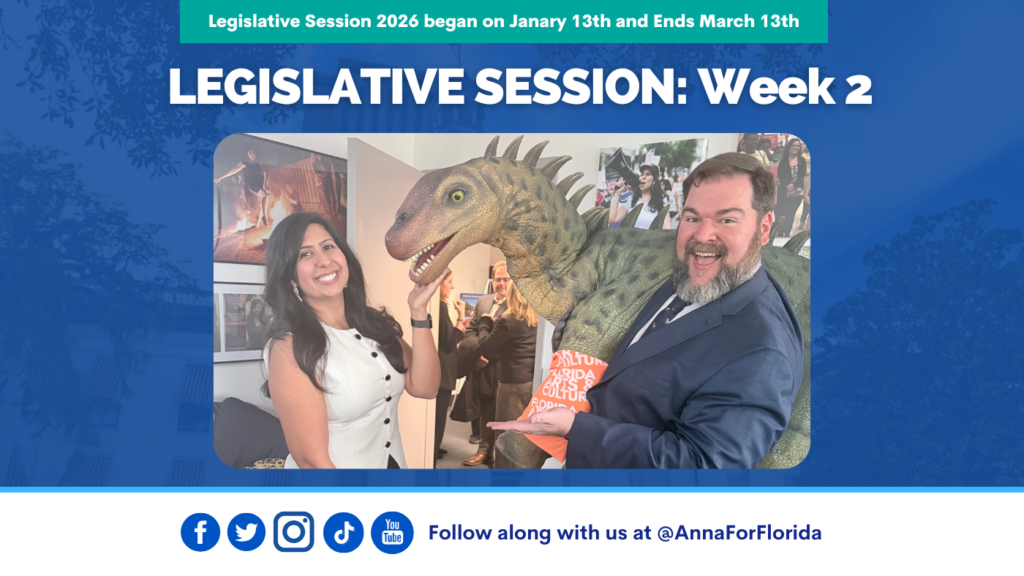
I am en route back to Tallahassee for the third week of the 2026 Legislative Session, which is supposed to last 60 days – nine weeks in all. But before we get going again, I wanted to get you an update from week two.
The second week of Session is always when the pace really begins to pick up, and this year was no different. We had the first hearings on a couple of important bills dealing with AI and data centers. The House and Senate both begin moving forward with ambitious plans to restore Central Florida’s Ocklawaha River. And we saw some encouraging progress on bipartisan efforts to stop insurance companies from dodging excess-profit laws and the DeSantis administration from dodging public-records laws.
Unfortunately, the Legislature also moved forward with bills to ban more books from schools, force students to watch anti-abortion propaganda, and enable fringe activists and our bad faith attorney general to use the courts to harass teachers, doctors and others.
You’ll find updates on all those bills – and many more – in our Weekly Update below.
As always, please remember to connect with us on our social media channels: Facebook, Twitter, Instagram, and YouTube. We use those platforms to get folks news, updates and action alerts in real time, which is especially important during the fast-moving session where bills can suddenly begin moving out of the blue and last-minute amendments can surface at any time.
We can still influence the agenda in the Capitol and shape the ultimate outcome of the 2026 session, as long as we pay attention, work quickly and pull together.
Onward,

A bill meant to ban more books from schools
The “Free State of Florida” has become infamous across the country for the number of books it has banned from its public schools – including many classic works of literature and stories involving themes like civil rights struggles and LGBTQ+ experiences.
The state-imposed censorship would become even worse under House Bill 1119, which passed the House Education Administration Subcommittee last week.
This legislation would forbid school districts from considering the literary or artistic value of books that activists want banned from school libraries. Basically, what that means is that a single extremist activist – or, more likely, Florida’s current extremist attorney general and education commissioner – could have books removed from schools based solely on a few sentences depicting something they don’t approve of, like two queer people kissing.
HB 1119 is moving quickly. It’s going to get its second hearing this week.
A big education bill would add anti-abortion propaganda to the curriculum and make schools let all law enforcement officers onto campuses
Meanwhile, the House Student Academic Success Subcommittee passed another bill meant to further politicize Florida’s public schools.
There’s a lot in House Bill 1071, and not all of it is bad. But one really gross provision would force school districts to show anti-abortion propaganda to all students, starting in the sixth grade. This is what’s known as a “Baby Olivia” bill, because the language originates with an anti-abortion group called Live Action that has produced a misleading, computer generated animation of a fetus and has been pushing states around the country to make that video a mandatory part of their school curriculums.
The sponsor of the legislation has added a provision to the bill that requires the cartoons shown to Florida students to be “medically accurate.” But it also leaves the decision about whether a video is medically accurate not up to doctors or other medical experts – but up to the governor’s political appointees on the State Board of Education.
Another provision of this bill would require schools to allow any law enforcement officer onto campus – which I’m concerned could be used as a loophole to let ICE agents raid our public schools. The bill sponsor says that’s not her intent, so I’m hopeful we’ll be able to tighten up that part of the legislation.
I also wanted to flag two more education bills that moved forward last week.
House Joint Resolution 583, which passed the House Education & Employment Committee, would put a constitutional amendment on the 2026 ballot that would further erode the separation between church and state and create a constitutional right to “religious expression” in public schools.
And House Bill 4027, which passed the Education Administration Subcommittee last week, would put a local referendum on the 2026 ballot in Hillsborough County to turn the superintendent of the Hillsborough school district into an elected position, as opposed to one appointed by the local school board. This comes after the DeSantis administration has clashed with current superintendent for not being aggressive enough in banning books from Hillsborough County schools.
A new round of anti-trans attacks – with potentially far-reaching consequences
My Republican colleagues have, sadly, launched yet another attack on the transgender community – one that could have dangerously far-reaching consequences.
The bills I’m referring to are House Bill 743 and Senate Bill 1010, which would expand a state law prohibiting doctors from providing gender-affirming care to anyone under the age of 18. The changes would criminalize anyone who “aids and abets” a healthcare provider – potentially exposing therapists who counsel trans teenagers, pharmacies that fill prescriptions, and even family members who simply support their loved ones to criminal charges.
In addition, the bills would give Florida’s attorney general – who is currently an amoral, far-right zealot who is at the center of the “Hope Florida” scandal – broad new powers to harass healthcare providers who treat LGBTQ+ youth, by allowing him to manufacture alleged violations under the anti-trans law and launch investigations based off of those allegations.
The Senate bill goes even further. It would also give parents the right to sue public school teachers and other public workers for alleged violations under Florida’s “Parents’ Bill of Rights” – an intentionally vague law that includes, for instance, the right to “direct…the moral or religious training” of a minor.
House BIll 743 passed the House Criminal Justice Subcommittee. Senate Bill 1010 passed the Senate Children, Families and Elder Affairs Committee.
In many ways, HB 743 and SB 1010 can be seen as unscientific attacks on healthcare. Which would put them in the same bucket as another bill that cleared its first committee last week.
That bill is Senate Bill 408, which passed the Senate Regulated Industries Committee, and would create a new cause of action that could enable people to sue the manufacturer of a vaccine if they experience any side effects. It’s such a broad cause of action that it sure seems like the goal is to deter vaccine manufacturers from marketing their products at all in Florida.
A fiscal crisis in the making
While we still have no idea what Gov. Ron DeSantis or the Florida Senate want to do, the House keeps plowing ahead with misguided property-tax plans that would create a completely avoidable fiscal crisis if they were to pass.
Two bills moved forward last week. The first is House Joint Resolution 203, which would eventually eliminate all city and county property taxes on homestead property. That would wipe out roughly $20 billion a year in local tax collections – would utterly devastate communities ability to fund community parks and neighborhood programs, police and fire protection, road resurfacing and sidewalk construction, garbage collection, animal shelters, mosquito spraying and so much more.
The second is House Joint Resolution 213 which would dramatically tighten property tax assessment caps. Under that proposal, the assessed values of homestead properties could grow no more than 3 percent every three years (versus up to 3 percent a year right now) and the assessed values of all other property could grow no more than 15 percent every three years (versus 10 percent a year right now).
While this would be a softer financial hit in the short term, it would create even bigger problems in the long road – but worsening the inequities in our current tax system in which two neighbors who own identical houses can pay wildly different property tax bills based simply on when they bought their home and giant land-owning corporations are paying millions of dollars less than they should because we have been artificially suppressing the taxable value of their properties.
Florida is in an affordability crisis right now. But simply gutting local property taxes – which would ultimately drive up home prices and rent, lead to large increases in more regressive taxes like the sales tax, and force deep cuts in investments that improve the quality of life in a community – would make the situation worse not better.
If we’re going to be serious about helping working families, then we should be focusing on reducing the cost of property insurance, expanding access to healthcare, building more affordable housing and steering tax breaks to the working and middle-class families who truly need it.
Turning mayors, county commissioners and town council members into pawns of Tallahassee
What’s really driving the property tax debate in Tallahassee right now is power.
While so many of Republican colleagues claim they are trying to help homeowners, what they are actually trying to do is disempower local communities. Robbing cities and counties of the only major revenue source they control would turn independently elected mayors, county commissioners and town council members into supplicants who are dependent on the governor and Legislature to provide funding for their communities’ needs.
It’s about consolidating all political power in the hands of a few politicians in Tallahassee, who are insulated from accountability by gerrymandered legislative districts and literally hundreds of millions in donations from special interests who control the agenda in the Capitol.
And we’re seeing a lot more bills in that vein, too.
Last week, for instance, the House Civil Justice Subcommittee passed House Bill 105, which would essentially give big businesses the ability to sue local governments and stop them from enforcing rules like land-development regulations.
And the House Intergovernmental Affairs Subcommittee passed House Bill 103, which would erase all city and county local business taxes – stripping yet another independent revenue source away from local governments across the state.
Big debates begin on AI and data centers
The Florida Senate held its first hearings on two of the biggest issues this session: Artificial intelligence and data centers.
The Senate Commerce and Tourism Committee passed Senate Bill 482, which has been branded as the “Artificial Intelligence Bill of RIghts.” The legislation would require AI companies to ensure parents can control a child’s interactions with an AI chatbot, require disclosures when a user is communicating with AI rather than a real human, and establish rules around using someone’s name, image or likeness without their consent.
At the same time, the Senate Regulated Industries Committee passed Senate Bill 484, would establish new regulations for large data centers. Among other things, the bill would require the Public Service Commission to set rules meant to ensure that data centers and other very large consumers of electricity pay the full costs of the power they consumers and to ensure that other utility customers don’t end up subsidizing them.
There are some good provisions in both of these bills. But they also could be much stronger – for example, setting rules to prevent abuses of AI in things like surveillance pricing and employment discrimination and ensuring that we have strong mechanisms to enforce these rules.
Good news and bad news for Florida’s environment
It was a bit of a mixed bag on the environmental front last week.
The House and Senate both advanced bills that would pave the way for the restoration of the Ocklawaha River, the biggest tributary of the St. Johns River.
House Bill 981, which passed the House Natural Resources and Disasters Subcommittee, and Senate Bill 1066, which passed the Senate Environment and Natural Resources Committee, would require the Department of Environmental Protection to develop a plan to breach the Rodman Dam, which was built more than 50 years ago as part of an abandoned plan to build a barge canal across Florida and severs the historic connection between Silver Springs and the St. Johns.
The Senate Environment and Natural Resources Committee also passed Senate Bill 958, which sets a statewide baseline for local governments that want to regulate the kinds of straws and drink stirrers that can be used in their communities. Basically, if a community wants to ban single-use plastic straws, this bill would require that any paper straws allowed in their place meet certain minimum standards – such as being biodegradable.
The Senate Community Affairs Committee passed two developer-backed bills: Senate Bill 548, which would give homebuilders more legal ammunition to block increases to local impact fees, and Senate Bill 686, which would make it easier to build residential subdivisions on agricultural land adjacent to already-developed areas.
Bipartisan bills: Cracking down on insurance company profit shifting, speeding up public records requests
There were several really encouraging, bipartisan bills that began to move forward last week that I’m hopeful we’ll eventually get across the finish line this session.
The House Insurance & Banking Subcommittee passed House Bill 1399, which put new limits on the ability of property insurance companies to move money between subsidiaries and evade limits on excess profits.
The House Government Operations Subcommittee passed House Bill 437, which would require state agencies and other governments to respond more promptly to public records requests.
And the House Criminal Justice Subcommittee passed House Bill 745, which would allow people who adjudicated guilty of non-violent crime but then maintains a conviction-free record for five years to have their criminal history records sealed – so that a single mistake doesn’t turn into a lifetime sentence when it comes to things like job searches.
Helping Big Sugar, hurting laid-off workers
But on the other hand, we continue to see some gross corporate giveaways moving forward, too.
The House Commerce Committee passed House Bill 433, which enable Big Sugar to sue Everglades activists and others who criticize the industry’s pollution and public-health practices.
And the Senate Tourism, Transportation and Economic Development Appropriations Committee passed Senate Bill 216, which would add even more unnecessary bureaucracy and intentionally burdensome paperwork to workers trying to claim unemployment benefits after they get laid off from a job.
Sowing division as a means of distraction
One way the Florida Legislature tries to hide the corporate favors it passes from the public is by simultaneously working on a bunch of other bills whose main purpose is to attract media attention, sow public division, and create useful distractions.
A few bills that I would put into that category include House Bill 125 and Senate Bill 193, which would create a memorial “Day of Remembrance” for Charlie Kirk, the conservative media personality who was murdered last year. The assassination of Kirk was a heinous act that we should all condemn. He often used intentionally hurtful and dangerous rhetoric to attack other people and create controversy, hence why there is disagreement over supporting this bill.
HB 125 passed the Government Operations Subcommittee and SB 193 passed the Senate Education Postsecondary Committee. Before the Senate committee approved the bill, the senators who supported it rejected a proposed amendment that would have expanded the legislation to include a similar day of remembrance for George Floyd.
In a similar vein, the Senate Tourism, Transportation and Economic Development Committee passed Senate Bill 246, which could create a new state license plate for the Ultimate Fighting Championship.
An appointed attorney general who thinks he is above the law
Lastly, I wanted to take a moment to note some gross bigotry – and authoritarian-like legal overreach – by James Uthmeier, the Ron DeSantis lackey who has been installed as Florida’s unelected attorney general.
On Monday – which was Dr. Martin Luther King Jr. – the attorney general issued a legal opinion declaring that his office will no longer enforce or defend dozens of state laws that are designed to address historic racial inequities because he has personally deemed them unconstitutional.
These are all laws that passed with bipartisan support, and they do support causes like recruiting more minority physicians to Florida and helping minority-owned businesses bid on government contracts.
This is both ugly and corrupt: While state or local officials routinely seek legal opinions from the Attorney General’s Office, Uthmeier abused this process by requesting this opinion himself. And the attorney general’s job is to defend state laws, not to enforce only the ones he personally supports.
But then again, James Uthmeier has long since proven to be someone who thinks the rules don’t apply to him. This is the same person who, as Ron DeSantis’ chief of staff, presided over the misappropriation of $10 million in public money – the scandal in which $10 million of Medicaid money was funneled through “Hope Florida” and then into a political committee that James Uthemeier personally controlled.
We’re still awaiting the results of a criminal investigation into the Hope Florida scandal. So perhaps James Uthmeier will soon learn that is absolutely not above the law.